Editor’s Note: The content in this article were first presented by Stuart West and Marcia Keener of the National Park Service during the 1st International EarthCache Mega-Event in Maine, USA on 2 September 2012.
By Stuart West and Marcia Keener of the National Park Service, Edited by Jenn Seva
Are you interested in developing EarthCaches on lands managed by the National Park Service (NPS)? Our friends at the NPS provided pointers so that more EarthCaches might be permitted. Remember that geocaches are prohibited on these lands until they are permitted. You must ask for permission first. There is no guarantee a request to place a cache will be fulfilled. But odds are good. To date, close to 75 EarthCaches have been permitted on NPS managed lands!
Basics
The NPS was created in 1916. Those of you doing the math will realize that 2016 will represent quite the milestone! Today, there are nearly 400 units, like parks and scenic trails, within the NPS. Although we commonly call them all national parks, only 58 have that official designation. The complete list details all NPS units. There are national monuments, national seashores, national rivers, national historic sites, and the list goes on. For simplification, we will call all NPS units “national parks” in this article.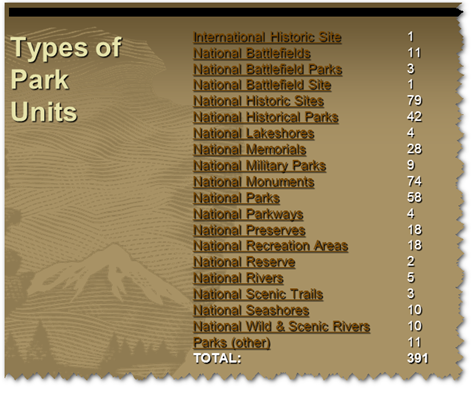
Why is this NPS designation important? Because that gives you an idea of the purpose of a park and a clue as to whether or not geocaching might be permitted. Why was a particular national park established? Do you understand its history? What must managers do to protect it? What are the interpretive or education plans? How might you help carry out their mission?
National parks are managed to a high standard, but do differ on types of activities that are allowed. The likelihood of getting a geocache placed in a national battlefield park is much less likely than a national recreation area (NRA). National battlefield parks may not even permit kite flying or Frisbee throwing because those activities are deemed inappropriate over the gravesites and hallowed grounds of those who have died for our freedoms. Conversely, geocaching may be deemed appropriate for some areas in a national recreation area. Always keep basics like the park’s mission in mind when thinking of proposing a geocache.
National parks are run much like cities. Both have a police force, fire department, and rescue squad. They both have roads to repair and they both have educators, buildings to maintain, and trash to manage. Detroit is managed differently than Los Angeles, and LA is not managed exactly like New York, Atlanta or New Orleans. No two parks are managed exactly the same way. Cities and parks face a variety of unique challenges based upon climate, topography, government infrastructure, job opportunities, and available funding. Consider that a city exists in a particular area for specific reason. A national park is set aside to protect a specific natural or cultural resource.
So, you have an idea for an EarthCache in a nearby national park.
The following tips will likely save you a lot of time and effort.
- First task is to find out who will be your contact in the park before you put too much time into scoping out a possible cache location or creating text.
- In some parks, your point of contact will be the Chief Ranger, the person who is responsible for managing law enforcement in the park.
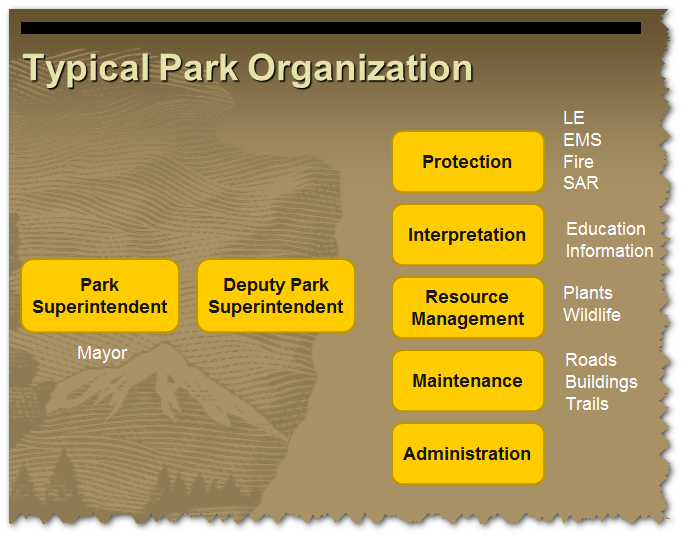
- It may be the Chief of Interpretation, responsible for education and information.
- The Chief of Resource Management may be your contact especially when plants and wildlife health are of concern.
- It is usually one of these three chiefs that will be your point of contact. In smaller parks some chiefs may manage multiple disciplines, making your search easier.
- In some parks, the duty of managing Geocaches may fall to the Special Park Uses Coordinator (people often have numerous duties or roles in parks), especially if that park requires a permit for placing a cache.
- Everyone in the park reports to the park superintendent or manager.
- In some parks, your point of contact will be the Chief Ranger, the person who is responsible for managing law enforcement in the park.
- Set up an in-person appointment with that person if possible.
- Be patient. If park staff are unfamiliar with geocaching or are new to this request, it may not be clear who will handle cache requests – and approval will always be interdisciplinary. In other words, although there may be one “lead,” several people may need to be consulted to get permission.
- Be informative. Many people do not have experience with EarthCaches. Some have had or heard about negative experiences with geocaches so they may or may not want to learn more. Perhaps you can demonstrate or teach the activity to park staff.
- Be flexible. Provide the coordinates you plan on using. Better yet, walk to your proposed location. You may get good feedback and answer questions in the field. Park staff will consider safety, resource damage, and possible theft of archeological or natural resources.
- Be informed about the park’s purpose. Explain how your proposed cache, especially an EarthCache, might support the mission and help draw and teach visitors about the park’s resources, or that park’s story about our Nation’s heritage.
- Next Steps
- Determine whether you need a Special Use Permit by discussing the proposal and applying for one if necessary.
- When proposing an EarthCache, remind managers that EarthCaches were developed in partnership between the Geological Society of America, the NPS and Geocaching.com.
- Always be mindful of other responsibilities that park staff have. Give them ample time to review your proposal. Gentle reminders might be appropriate if many weeks have gone by.
- Remember that managers have the full right to approve or deny the application, have final say over content, and can insist that a cache be removed if there is a problem.
- After you get park permission, submit your plans to Geocaching.com. Your EarthCache description must be reviewed by the park staff prior to final submission.
Federal Regulations That Affect Traditional Geocaches
EarthCaches focus on geoscience feature of our Earth and so do not need a container like traditional geocaches do. National parks enforce the regulations listed within Title 36 Code of Federal Regulations (36 CFR) when caches use physical containers. This is in violation of established regulations until permission is granted by the park superintendent and written within the Superintendent’s Compendium, the document of park-specific regulations. Two sections of 36 CFR are typically used to enforce park prohibitions against physical geocaches. A third regulation, 36 CFR §2.1 Preservation of natural, cultural, and archeological resources, has also been cited in cases where geocachers disturb the environment to conceal their caches. The two most common violations cited are violation of a park closure and abandoned property:
36 CFR §1.5 Closures and Public Use Limits … based upon a determination that such action is necessary for the … protection of environmental or scenic values, protection of natural or cultural resources … , or the avoidance of conflict among visitor use activity, the superintendent may: (2) … Impose conditions or restrictions on a use or activity.
36 CFR §2.2 (a) Property: The following are prohibited: (2) Leaving property unattended for longer than 24 hours except in locations where longer time periods have been designated or in accordance with conditions established by the superintendent.
Again, permission from park managers is required before any geocache can be placed on national park lands. Caches using physical components may be best in developed areas or requested near visitor centers.
See stories on successful placement of physical caches in North Cascades and a Do-It-Yourself GeoTrail turned GeoTour.
Reference Material
- http://www.earthcache.org/: Read the submittal guidelines linked from the main navigation.
- http://www.geocaching.com/about/guidelines.aspx: All EarthCaches are a type of geocache so they are also subject to the usual Geocaching.com guidelines.
- http://www.nps.gov: Experience Your America ™
- http://www.nps.gov/acad/earthcache.htm: EarthCache at Acadia National Park
- http://www.nps.gov/shen/planyourvisit/earthcaching.htm: EarthCache at Shenandoah National Park
- http://www.murieslc.org/static/1958/earthcaching-in-denali: EarthCache at Denali National Park and Preserve