Discovering a Vanishing Geocaching Series – The Last A.P.E. Cache

Geocachers otco, gsilberbestlife, kulhal

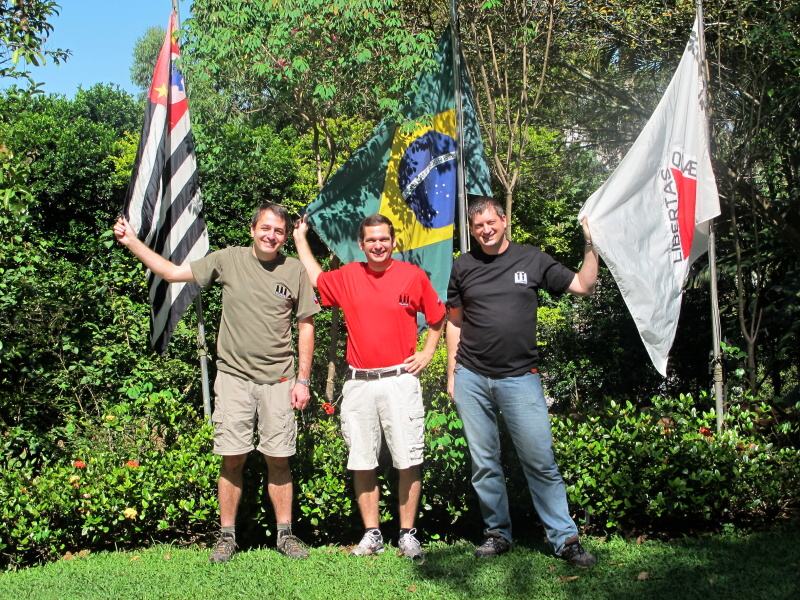
Geocachers kulhal and otco  recently embarked on a journey to locate the last cache in a vanishing series. The duo traveled half way around the world to claim a “found it” on the final active cache in the Project A.P.E. cache series. To many geocachers, the Project A.P.E. caches ring a nostalgic bell.

The A.P.E. cache series was established in May of 2001. The promotion was for the film Planet of the Apes. Thirteen different A.P.E. caches, each with props from the movie and a story that tied into the movie, were hidden all over the world. Those who found the caches received a unique icon.

All that is left of the highly sought series is a single, active cache hidden deep in the tropical jungles of Brazil. Mission 4: Southern Bowl  is now the last obtainable A.P.E. cache. The remainder of the geocaches in the series have been archived. The final cache has been logged less than 40 times.

Project A.P.E. Cache Icon

kulhal and otco met up with Brazilian cacher, gsilberbestlife, when they arrived. According to kulhal, the excitement of discovering the last of the vanishing series only heightened the caching crew’s sense of adventure.

Early one morning, otco, gsilberbestlife, and kulhal piled into their rental car and drove 300 km outside of Sao Paulo, Brazil. They arrived at Intervales State Park, the supposed location of the lone standing A.P.E. cache. Along the way, the cachers were surprised to find that many locals were unaware of the park’s existence. This further motivated them to discover the rarely visited cache.

According to kulhal, experiencing the beauty of the park was just as much of an adventure as discovering the cache, “I equally appreciated the fact that the cache brought me to a place that I would have never visited otherwise. I experienced a wonderful part of the world and saw nature so different from what I know from home.”
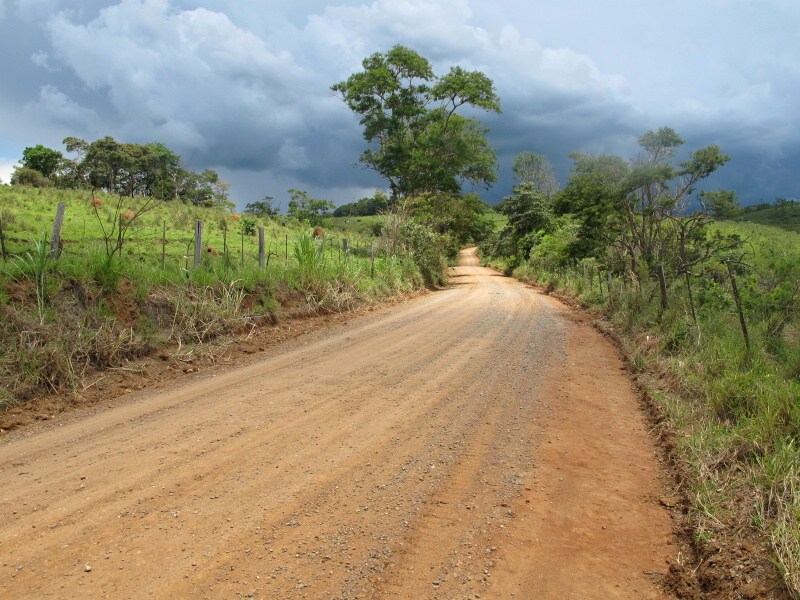
The roads through Intervales

Using a sketchy GPS signal to navigate windy, unmarked dirt roads, the cachers were able to drive within 100 meters of the cache. Now only a few minor obstacles stood between the cachers and the final A.P.E. cache. Wild animals, jungle-like terrain, and a lack of a trail map couldn’t stop these cachers.

Otco, gsilberbestlife, and kulhal discovered the cache successfully, noting that, “The beauty of this cache is something else.”  Kulhal stated, “I had a feeling that I was touching a piece of geocaching history and for that it was a special moment.”

It’s a special moment geocachers may continue to share. There have been more logs in the past 2 years than in the nine years after the cache was placed. And because this is the final A.P.E. cache, it is likely that an increasing number of geocachers will be traveling to Brazil. Located in a new exotic setting, the Mission 4: Southern Bowl is an opportunity for geocachers to discover a significant cache.
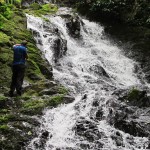
Waterfall in Intervales State Park

The story doesn’t end here. For more information on kulhal, otco, and gsilberbestlife’s adventure, check out their Czech language blog.
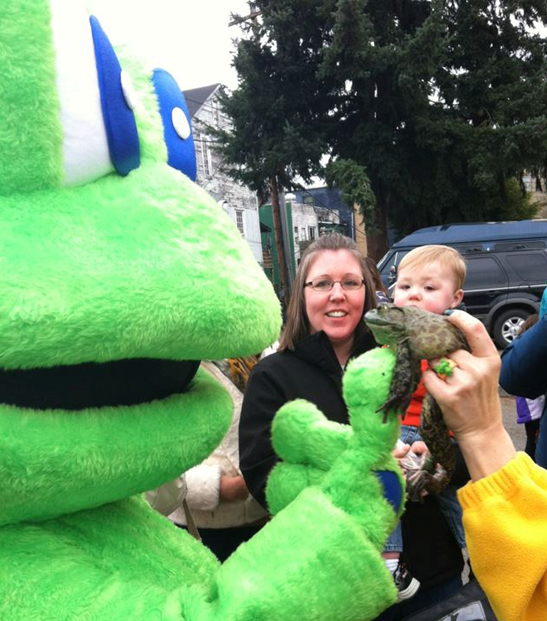
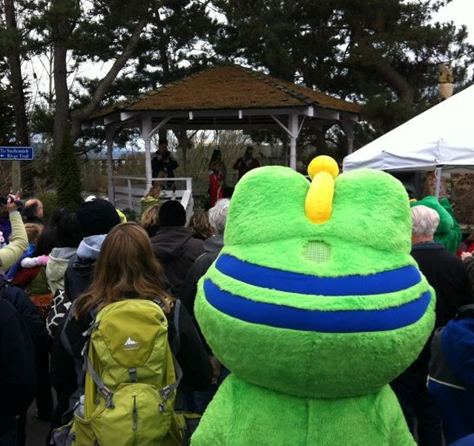
Groundhog Day? Try GroundFrog Day – Geocaching Mascot Signal Attends

Signal with Snohomish Slew

By: Annie Love, Groundspeak Lackey

Why wait until February to get a weather prediction from Punxsutawney Phil when you can get one from Snohomish Slew in January? Snohomish Slew is a real frog billed as “the Meteorologist Frognosticator extraordinaire and mighty small hero to all the weather weary.” Last Saturday, he forecast what type of weather the Northwest United States might expect in the next six weeks: more winter or an early spring.

Every year the quaint little town of Snohomish, Washington (located about 30 miles northeast of Seattle) welcomes Slew for a frog-filled celebration to predict the end of winter. It’s known as GroundFrog Day.

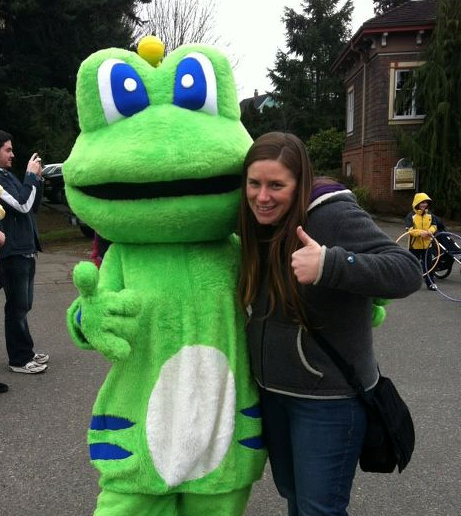
We here at Groundspeak think that you can trust frogs over groundhogs any day, so we took our beloved mascot Signal to witness Slew’s prediction. Signal is a life-sized frog, with GPS capabilities (of course). Fellow Lackey Nicole (Louie Bliss) and I had the pleasure of escorting Signal to the event. Lots of high-fives and hugs were to be had with the kids in attendance. Kids weren’t the only one who stopped to get their picture taken with Signal – in most cases it was the parent who really wanted the photo with our own geocaching legend.

Signal watching Slew predict the forecast

The event included lots of dancing to frog remix versions of songs, hula-hooping, the GroundFrog royalty arriving via fire truck, and various booths to visit. After Slew took the stage to make his prediction, Signal was fortunate enough to shake webbed toes with the weather-casting celebrity.

What was Slew’s final prediction, you may be wondering? The final answer, as posted on the official website, was a bit vague: a Spring/Winter mix of weather is ahead.

Signal and Lackey Annie Love

“’Whether the weather be fine, Whether the weather be not, Whether the weather be cold, Whether the weather be hot, We’ll weather the weather, Whatever the weather, Whether we like it or not’ interpretation – neither 6 weeks of winter or spring, spring will come and sunny days, there’ll be a few, but still some cold days ahead, too.”

Either way, the current extended forecast for Seattle shows a lot of sunshine in our near future.  We think Signal may have had a little help with that.

Geocaching.com Teams Up with Tomb Raider®

Geocaching.com is excited to be teaming up with the action-packed experience of Tomb RaiderCrystal Dynamics™, a Square Enix™ studio produces the video game series. The worldwide phenomenon launched in the mid-1990’s and has since been portrayed in Hollywood blockbusters.

Geocaching.com is a natural fit to join forces with the video game featuring world explorer Lara Croft™. A new campaign of treasure-hunting adventure will preview the upcoming release of Tomb Raider.

Through a variety of initiatives this year, Crystal Dynamics and Geocaching.com will create a series of unique location-based adventures. The experiences embody the spirit of Tomb Raider and Lara Croft’s drive to discover new adventures and locations.

“Many of us have been playing Tomb Raider since the first game launched in 1996, and we are excited that Geocaching.com is partnering with Crystal Dynamics on this project” said Jeremy Irish, CEO of Groundspeak, the company the runs Geocaching.com. “Tomb Raider is all about exploration and discovery. It inspires the adventurer in all of us, much like geocaching does, and we are excited about the opportunities that this project presents for both geocachers and Tomb Raider fans worldwide.”

To develop these adventures, Crystal Dynamics will be tapping into both the traditional Geocaching.com treasure hunting format and Geocaching.com’s latest photo-based adventure project Geocaching Challenges.  More details about future activities are not being released just yet. Subscribe to this blog for the latest updates in the coming months.

You can explore Geocaching Challenges for free on the iPhone, Android and Windows Phone 7.

You can also read more on the Official Tomb Raider Blog.


Happy Birthday EarthCaching – EarthCaches Turn 8 Today

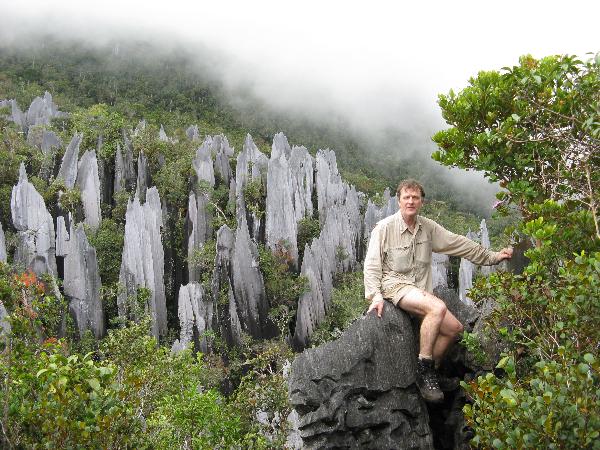
"The Pinnacles" EarthCache in Malaysia (GC19A54)

The world’s first EarthCache turns eight-years-old today.  Saying “Happy Birthday!” is as easy as logging an EarthCache. Chances are there’s one close to where you’re sitting right now. There are plenty of EarthCaches, think thousands and thousands, around the globe. But that wasn’t the case back in 2004.

“Earthcache I – a simple geology tour of Wasp Head” (GCHFT2) triggered a seismic movement in geocaching. The first EarthCache was located in Australia. It was placed by geoaware on January 10, 2004. Since then more than 17,000 EarthCaches have been published, popping up on every continent on the planet.

Each EarthCache must share specific characteristics before being published. There’s no physical cache. At every EarthCache, geocachers learn about the forces that sculpted the earth. EarthCaches showcase volcanoes, seismic fault lines, salt flats, bizarre rock structures and more. Each Earthcache reveals how scientists understand our planet.

EarthCache at a green sand beach in Hawaii "Olivine" (GC1M15H)

To log an EarthCache geocachers must demonstrate to the cache owner what they learned about a specific geological feature. Geocachers might measure a rock structure or record a tidal movement. At the EarthCache “Olivine” in Hawaii, geocachers must answer questions about the unique green grains of sand.

EarthCaches are gaining in popularity as they grow older and more established in the geocaching world. Organizers are even hosting the first International EarthCache Event (GC33E6X) this year. It’ll take place in September near Portland, Maine, USA. More than 250 geocachers have already logged a “Will Attend.”

You can learn more about EarthCaching by watching the video below.

[vsw id=”f11fxuNsaE8″ source=”youtube” width=”425″ height=”344″ autoplay=”no”]

The Eureka Moment: Challenges

Jeremy Irish: CEO and Co-Founder of Groundspeak

By Jeremy Irish,

To me, the core geocaching experience is the “eureka moment” when finding a cache.

The word, Eureka, comes from the ancient Greek εὕρηκα heúrēka, meaning “I have found it.” I love this word. It represents that elated feeling of discovery when you move a few leaves to discover that container in the woods, or reaching under a park bench to extract a magnetic key holder. It is a sense of accomplishment and marks the end of a successful journey.

Finding a geocache is fun and rewarding, but I’ve always been frustrated of the limitations of a geocache. As a physical object, some places are inappropriate for placing a cache. They can’t be hidden close to each other to reduce confusion, many locations have to be regulated by land managers, and some locations just can’t support a hidden container. But there are lots of cool and interesting eureka moments in the world. So how can we get people there without a cache?

We tried this before. Our early attempt was to support virtual caches, which weren’t geocaches at all but unique locations on the world for people to discover. The best of those virtuals still exist today as grandfathered listings, but there was a time when virtuals were hard to qualify. The biggest reason was that we were applying the guidelines of geocaches to virtuals, which required a reviewer to publish them. No one could determine what the subjective threshold for what was a virtual was and wasn’t, so the constant angst resulted in the retiring of virtuals. For years we have focused on the core game of geocaching, but have always wanted to find a way to bring virtuals back.

Click on the image for a preview video of "Geocaching Challenges"

Spring forward to 2010 when we added the feedback section of our web site. It became quickly apparent that the community wanted virtuals back as much as we did. However, knowing the history of virtuals, we couldn’t just flip a switch and have the same process again. So we sat in a room and tried to distill the idea of virtuals into one sentence. The result was “go somewhere and do something.” This evolved into Geocaching Challenges.

Find a location of interest and challenge someone to take a photo or complete some kind of task unique to that location. Make it fun! Take a picture of yourself holding up the Tower of Pisa. Pull statue Lenin’s finger in Fremont (Seattle). We’re looking for the community to define the best challenges in the world.

We also know in the early days that there won’t be many Challenges, so we’ll be issuing Worldwide challenges daily. For those old timers, these challenges will be like the old Locationless caches. For example, we’ll challenge you to take a picture of yourself on a boat, kissing a frog, or dressed like a pirate. We’ll be using our feedback site as a way for the community to suggest Worldwide Challenges.

What are the guidelines for issuing a challenge? Unlike caches, there aren’t any official guidelines. Instead, you can rate challenges with thumbs up or thumbs down, and there are reporting tools available in the case that a challenge is inappropriate or unavailable. We’ll be tweaking these tools and introducing new ones as the activity grows, to ensure that the community can collectively decide what is appropriate, and what isn’t. For example, there is no 520’ guideline and Challenges won’t be blocked from being issued at Disney World, or even a pub.

There will be some restrictions at the start. To reduce the growth during the early days, only Premium Members can submit challenges. Premium Members will be limited to creating a Challenge once every 24 hours. Our hope is that we’ll be able to open this up further once we tweak our system to address the feedback we get from the community.

We’re also releasing a whole new set of mobile applications for Challenges, on the iPhone, Android and Windows Phone 7. We expect that this new activity will be primarily accessed through these free applications, though we’ll continue to support GPS devices.

I’m very excited about Challenges, and look forward to seeing what the community can do with the new concept. I also look forward to constructive feedback on how to improve the activity and make it a part of the core geocaching experience.