Brick By Brick — Geocache of the Week

Traditional
GC5JB1H
by Troopbiz
Difficulty:
3
Terrain:
1.5
Location: 
West Virginia, United States
N 39° 28.282 W 080° 07.115

Why this is Geocache of the Week:

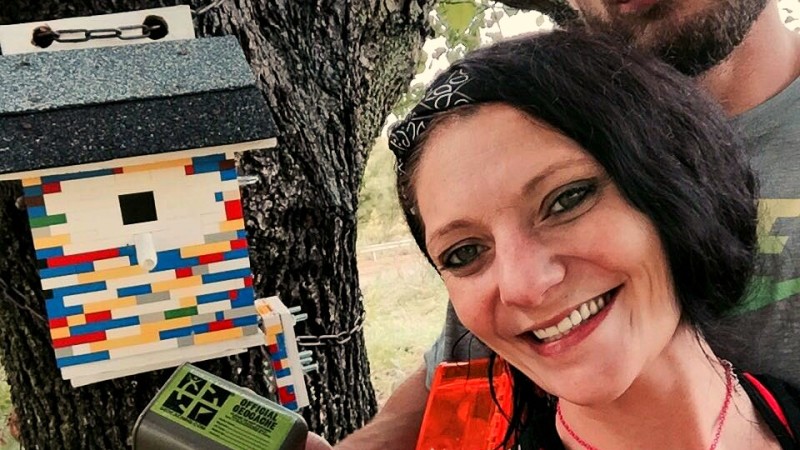
600 billion. That’s the number of Lego parts that have been released into the world since 1949, when the Lego Group began manufacturing the colorful interlocking bricks. Now, at least 100 of those parts have been re-imagined into this Geocache of the Week.

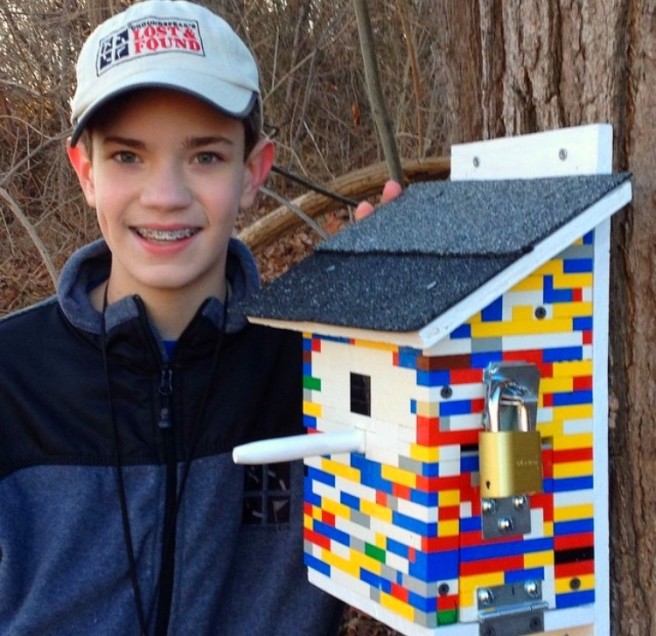
Despite its playful construction, this cache is serious business. If you reach GZ, finding the colorful birdhouse will be easy…but you’re only half-way there. The cache itself is behind a small door, which can only be opened by solving a field puzzle from the cache page.

Surprisingly, cache owner Troobpiz says the cache doesn’t need a lot of maintenance—a testament to the solid construction and to the Legos themselves. We especially like how the cache was attached to its tree: with easily adjustable chains.

So if you’re traveling near West Virginia sometime soon, check it out. If you feel like digging out your old Lego set afterwards, we’d understand.

Brick By Brick

What Geocachers have to say about it:

“TFTC This one is very special. A unique idea that makes you smile. Lots of swag in this adorable BRICK house. TN SL left a pink bangle for tiny wrists.” –Capone6

“I am always impressed by the truly clever containers that take time and effort to assemble. This is a beaut! Thanks for our fun after arriving here today en route home to Louisville.” –Ecce!

“I was in the Fairmont area this morning and new I had to stop by this new cache to see what all the buzz was about. This is an interesting twist on a container that we have all seen many times. Well done. I enjoyed the quick on-site puzzle. I had it solve correctly on the first try… the second calculation came out the same… and the third… and (you see the pattern. Finally, in a pinch, the lock popped open and I was able to sign the log. Well done. I have never seen one like it before. TFTC.” –arealwhit

What the Cache Owner, Troopbiz, has to say about it:

What inspired you to use Legos for the cache construction?
Ever since I can remember I have loved playing with Legos and building unique and creative things with them. I first had the concept of using these stackable toy bricks for a geocache when I saw a similar concept online. In that concept cachers had to count different colors to obtain the 4 digit lock combination. I took it a step further by making the cache out of Legos. I even designed a custom Lego door complete with a latch to allow cachers to access the geocache!

What’s been your reaction to all the nice logs and favorite points from geocachers?
I strive to put out unique and creative geocaches for geocachers to find. When I first hid the geocache I knew it would be a highly trafficked cache due to the location, but I didn’t expect 26 favorite points in the first year! It’s been fun reading all the nice logs and experiences that other geocachers have written, and that inspires me to hide more unique caches.

What’s your favorite geocache to find?
I enjoy finding creative caches that the cache owner has put some serious thought, time, and effort into. For this reason I enjoy multi and puzzle caches the best! More specifically I enjoy gadget caches. Gadget caches are easy to find, but you have to do something special to access the log. I am fortunate to have local cachers such as Killlerbee, Arealwhit, WVcachers3, and Dukemartin (Just to name a few) that strive to hide cachers to give the community a unique experience.

Do you have anything you want to say to the geocaching community?
If you don’t think you have the ability or creativity to hide a unique cache, think again. The internet has an abundance of great and unique cache ideas to get inspiration from. You can can the concept from one cache, change the theme, and make it a completely new caching experience! Some of the best caches I have done have been based on a common theme such as “The Gold Bug” (GC62631) or “Cap’n Morgan’s Booty” (GC5Y8AB). I have another cache entitled “Mission Impossible” (GC4NDPR) that is a 5 stage multi cache, and in each stage is a different puzzle cachers have to solve before they can advance to the next. So what are you waiting for? Get out there and create a unique caching experience. The community will thank you, and who knows… you may even be featured on the Geocaching Blog!

Photos:
0f736db0-8449-4d86-98bd-6f9a7b9a95dd47
Geocacher KristenTurner and friend make the find.
fdsfdf
Brick By Brick in all its glory.
Note: The cache was screwed into a tree for this photo, but this was not a permanent placement.
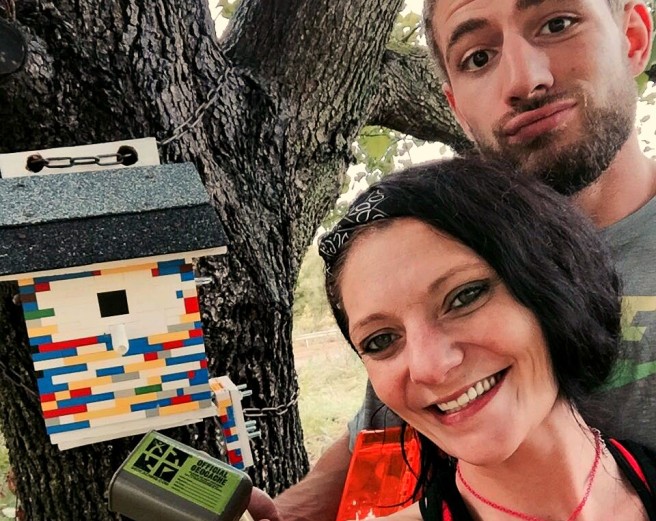
CO Troopbiz & his creation. Note: The cache was screwed into a tree for this photo, but this was not a permanent placement.

Continue to explore some of the most amazing geocaches around the world.
Check out all of the Geocaches of the Week on the Geocaching blog. If you would like to nominate a Geocache of the Week, fill out this form.

The World Wide Web of Spiders

Guest blog written by avid geocacher (and dedicated nurse) Kelley Piekarek*. 

A Floridian geocacher was reaching for a cache when she felt something bite her arm. Thinking nothing of it, she signed the log, replaced the cache, and moved on. Shortly thereafter her arm became red, swollen, and felt hot to the touch. The area surrounding the bite began to form what appeared to be an infection; her arm became very painful and she was running a high fever.

She went to the emergency room where it was confirmed that she had been bitten by a brown recluse spider. The area was surgically cleaned, she was put on antibiotics, and is now on the road to a full recovery.

Most spiders are absolutely harmless to humans. Of the 4,000+ species of spiders found in North America, only two are dangerous to humans—the brown recluse and the black widow

Geocachers are fortunate to enjoy the wonders of nature. But as we all know, nature can be a bit scary sometimes. If you are informed and aware of your environment, you can avoid spiders bites and know what action to take if you’re bitten.

Brown Recluse

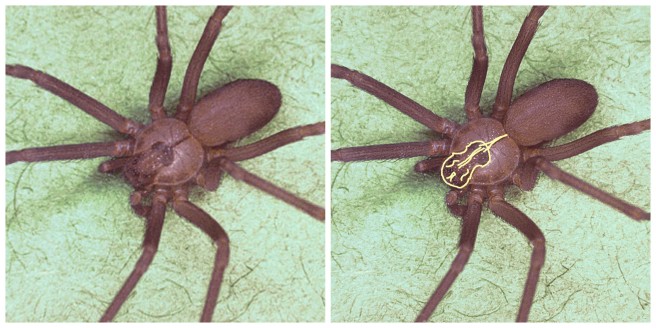
The brown recluse can be identified by the violin-shaped spot behind its eyes.

The brown recluse is ¼ to ½ inch long, and can be identified by the violin-shaped spot behind its eyes. They are native to North America and live predominantly in the Midwestern United States. 

Brown Recluse Map


Black Widow

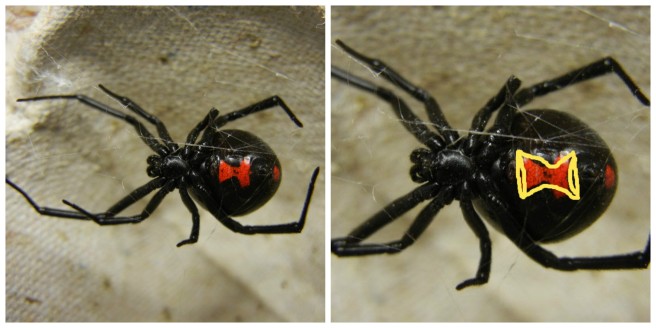
The black widow can be identified by a red, yellow, or white hourglass shape on their lower abdomen.

The black widow can be identified by a red, yellow, or white hourglass shape on their lower abdomen. There are many species of widow spiders found worldwide, but the North American variety is about ½ inch long.

Black Widow Distribution


Where do spiders like to hide?

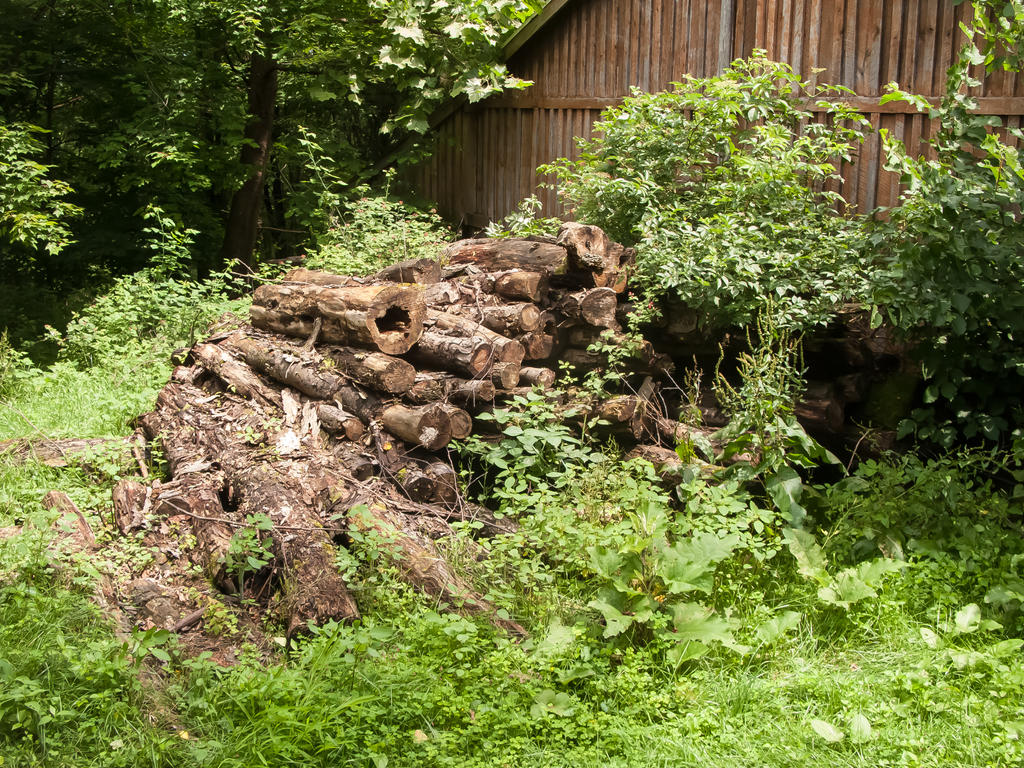
Spiders like to hide in wood piles

Spiders like to hide in wood piles

Both spiders are found in similar locations. Inside, they prefer to hide in small, dark locations such as closets, cellars, garages, vents, stored boxes, and within the cracks and corners of walls. Outside they prefer to live like a geocache—underneath rocks, in wood piles, and inside hollow tree trunks.


What do spider bites look and feel like?

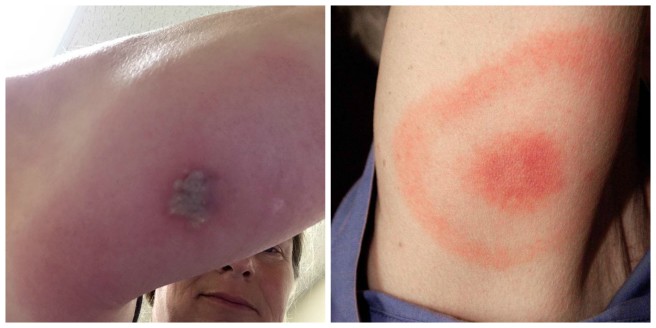
The bites from brown recluse (left) and black widow spiders (right)

The bite of the brown recluse is usually painless and goes unnoticed, but it may feel like a bee sting or there may be a burning sensation. Symptoms usually develop in 2-8 hours starting with a small white blister at the site of the bite.

Many bites will cause a small red mark that will heal without problems or scarring. However redness, blistering, an open sore, and a black area may develop and take months to fully heal. Other symptoms include severe pain at the site of the bite, severe itching, nausea, vomiting, fever, and/or muscle pain.

The bite of the black widow is similar to the brown recluse, and initially may look like two tiny Dracula fang marks. It feels like a pinprick, but also may not be felt at all. There may be slight swelling, redness and a spot that forms a target shape. Fifteen to sixty minutes later a dull muscle pain will spread from the bite area to the entire body. If the bite is on the upper body, the pain will be in the chest. If the bite is in the lower body, the pain will be in the abdomen.


What to do if you’ve been bit

Seek medical help if you think you've been bit by a brown recluse or black widow spider
Seek medical help if you think you’ve been bit by a brown recluse or black widow spider

Most spiders bites are non-venomous and require no specific treatment, but if you suspect you have been bitten by a brown recluse or black widow:

  • Seek medical attention right away
  • Remain calm to keep your circulation relaxed
  • Apply a cold pack to the area to relieve swelling and discomfort
  • Do not apply a tourniquet
  • If possible, bring the spider with you to the doctor’s office or ER for identification


How to avoid spiders

You’ve probably heard that spiders are more afraid of you than you are of them and that’s true. They’d prefer to avoid contact with humans all together, but they will defend their space. If you live in an area where co-existing with brown recluse and black widow spiders are part of the landscape, take some precautions:

Outdoors

  • Watch for spider webs, which are the most obvious signs a spider is nearby
  • Wear gloves and long-sleeved shirts, long pants, and sturdy shoes
  • Move rocks and debris with a stick when looking for your cache to protect your hands

At Home:

  • Keep your home clean and clutter free
  • Bits of food can attract bugs which will in turn attract spiders, so vacuum and wipe down surfaces often
  • Store your things in sealed plastic storage boxes or plastic bags with the edges taped shut
  • When unpacking stored items, shake items out thoroughly before use
  • Keep the sides of your home free of plants and debris
Keep your house clean and clutter free to avoid spiders

Stay safe out there, my friends. Be prepared and know what to do should a spider bite you, and keep on cachin’! 

How do you stay safe while enjoying your favorite hobby?


*If the name Kelley Piekarek sounds familiar, it may be from this story that made national geocaching news in February 2015.

¡El blog de Geocaching tiene un nuevo aspecto!

En Geocaching HQ, todos los días nos inspiran historias de gente que ha descubierto que la aventura aún existe en el mundo real — historias de exploración de lo desconocido, de lanzamiento de un rastreable al espacio o de ver cómo un niño descubre el mundo por vez primera.

Una de las mejores partes de trabajar en HQ es compartir estas historias con todos vosotros. Por eso estamos encantados de anunciar que el blog de Geocaching tiene un nuevo aspecto — uno que esperamos que coincida con las historias extraordinarias que guarda.

Adelante. Compruébalo. Entonces, comparte con nosotros tus comentarios sobre tus mejores momentos de geocaching.

Le Blog de Géocaching a un Tout Nouveau Design !

Au Geocaching HQ, nous sommes inspirés tous les jours par les histoires de personnes qui ont découvert que l’aventure existe encore dans le monde réel — des histoires d’exploration de l’inconnu, d’envoi d’objets voyageurs dans l’espace ou de voir un enfant découvrir le monde pour la toute première fois.

Une des meilleures choses lorsqu’on travaille au HQ est de pouvoir partager ces histoires avec vous tous. C’est pourquoi nous sommes heureux de vous annoncer que le blog de Géocaching a un nouveau design — que nous espérons correspondre aux extraordinaires histoires qu’il contient.

Allez-y. Allez le voir. Ensuite, partagez avec nous dans les commentaires vos meilleurs moments de géocaching.

Der Geocaching-Blog hat ein brandneues Design!

Hier im Geocaching HQ werden wir jeden Tag inspiriert durch Geschichten von Menschen, die entdecken, dass es im alltäglichen Leben immer noch Abenteuer gibt – Geschichten vom Entdecken des Unbekannten, von einem Trackable, dass ins All geschossen wurde und von Kindern, die zum ersten Mal die Welt erkunden.

Besonders große Freude bereitet es uns, diese Geschichten mit euch zu teilen. Deswegen freuen wir uns, das neue Design des Geocaching-Blogs anzukündigen – wir hoffen, dass das Design, die einzigartigen Geschichten, welche erzählt werden, widerspiegelt.

Los geht’s. Schau es Dir an. Und teile uns in den Kommentaren eine Deiner außergewöhnlichen Geocaching-Geschichten mit!