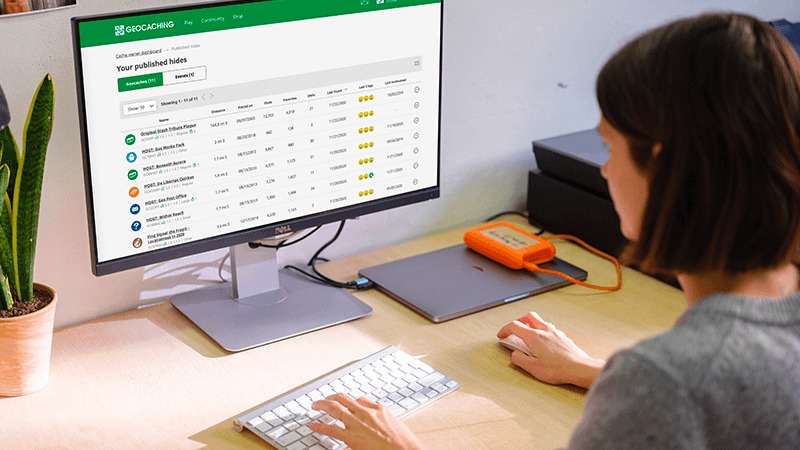
Jede Zeit ist eine gute Zeit für eine Cache-Wartung. Mit dem Wechsel der Jahreszeiten ist es ein besonders guter Zeitpunkt, um die neue Cache-Owner Seite zu nutzen, um Deine Caches zu überprüfen.
Continue reading →Author: Chris
Hopelessly addicted cacher and Geocaching HQ's public relations manager.
Inside Geocaching HQ transcript (episode 46): Attributes, searchable D/T grid and more with Nicole J.
[music]
00:15 Chris Ronan: Hello there. Welcome, this is the Inside Geocaching HQ, a podcast about what’s happening at HQ in Seattle. My name is Chris Ronan. My Geocaching username is Rock Chalk. I am one of the Lackeys who works at HQ, and on this episode, I chat with my fellow Lackey, Nicole, from the product team. If you are a long time listener of the podcast, you may remember Nicole coming on in the past to talk about her role on the Community Volunteer Support Team. Her amazing skills are now with the product team where she and her colleagues have released several interesting things in recent weeks and months, which we will discuss right now. Let’s do it.
[music]
01:04 CR: Okay, Nicole. Well, I was looking, I think you were last on the podcast about a year-and-a-half ago, and at that time you were the Community Volunteer Support Lead, and some things have changed, you’ve been doing different things since then, so maybe we can start by just talking about what you’ve been doing since then and what your current role is at HQ?
01:26 Nicole: Yeah. Hi, Chris. Good to be back on the podcast. Thanks for inviting me back. As you said, I was a Community Volunteer Support Lead, and then I transitioned into a product management role, so for the last year, year-and-a-half almost, I’ve been working with web developers and designers to create cool new features on the website and also some more business-critical projects. I actually have an upcoming change in my role, I’m gonna be more involved in the mobile world; I’m going to soon be the product manager on the mobile team as well.
02:03 CR: So that’s a pretty big change from the last time that we were talking to you, but I would imagine that you bring a lot of what you learned on the Community Volunteer Support Team and with working closely with the community into these roles that you have had since then, and certainly what you will be doing on the mobile team.
02:23 Nicole: Yeah, I’ve definitely learned so much being on the community team and working with volunteers, it has been… That was really bittersweet leaving the Community Volunteer Support Team because I have loved supporting the volunteers and being less involved with reviewers has definitely been a little bit of a drawback for me on an emotional level, but it’s been still really rewarding to work on the product side and support the community at large.
02:49 CR: So there have been a number of very exciting projects that you and the teams that you’ve been working with have released over the recent months, and we’ll go through a few of those things. I think one that is among the most visible is the new attributes that were launched at the end of August, and along with that, people can now search or filter for attributes on the website and on the mobile app, but as far as the process of bringing new attributes into the game, how does that even begin and what all goes into it because I think if I didn’t work here, I might think that it’s just a matter of loading a couple of images into a database somewhere and naming them and then saying, “You’re good.” But now that I work here, I realize this is a massive project that involves a lot of people and a lot of teams at HQ and outside of HQ as well.
03:45 Nicole: Yeah, that was a really fun project to work on, and as you said, it involved a lot of teams and a lot… It started out many months ago before the release; in essence, it is loading up a file and naming it, but you can’t just put it, like you don’t just put in one place there’s multiple different places. And then a lot of things that are interconnected and as all cache owners and non-cache owners geo-cacheers will know, there’re so many rules behind the scenes that need to apply, and you to make sure that all the rules for attributes are in place in all of the areas where they appear. We worked with so many teams at HQ from the web development, mobile development, the community team, the API team; almost everyone was involved in the planning and execution and release for this.
04:34 CR: And for people that may not be aware, what are the four new attributes and how did the decision come about to those four?
04:42 Nicole: So the four new attributes are the native solution check attribute, the power trail attribute, and the challenge cache attribute, and the bonus cache attribute. And so the decision on which ones to add to the attribute list, that also took a long time; we have a lot of information from forum posts where players have asked for attributes in the past, so we took that into account. We did brainstorm at HQ, we did a brainstorm with the community team and with volunteer reviewers as well. We wanted to make sure that we get attributes that are able to be used broadly and not just locally, and there are some examples of attributes that have been asked for that mostly apply to certain regions, so we did wanna make sure to have a more broader use for the attributes. Yeah, in the end, these were the four that we decided on.
05:34 CR: Yeah, I was disappointed. The bakery nearby attribute was not added. I had lobbied hard for that one and…
05:40 Nicole: It was the close call.
05:43 CR: You say that, I have a feeling that you didn’t give it much thought, but that’s fine, but what was exciting was that not just those four new attributes were added, but that you can now filter for attributes when you’re using the website and the mobile apps as well.
06:00 Nicole: Yes, as the initial project was scoped and planned, we really wanted to make it a win for the community with Pocket queries, those who know pocket queries, they use them, but for the uninitiated, it’s often quite difficult to get into it, and then all the intricacies that come with that. And so we really wanted to make it easier to search with Pocket queries and also search in the fields on the app without… Unless you have planned it ahead of time like doing a Pocket query on your phone, I don’t know if I would even ever attempt that.
06:33 CR: So how many caches are we talking about here that have been affected by these new attributes?
06:39 Nicole: So the solution check attribute is on about almost 90,000 caches worldwide; power trail, a little over 30,000 caches. About 30,000 caches have the challenge cache attribute, and not quite 10,000 have the bonus cache attribute.
06:54 CR: Well, that’s very cool. And then another project that is newer, the difficulty terrain grid, which is near and dear to my heart as a player, as you know. I love trying to fill up and continue to fill my D/T grid. It’s the D/T grid search. What would you like people to know about that project?
07:17 Nicole: Yeah, the D/T grid research is a pretty neat, simple, but pretty powerful search tool, and I personally love it. I mean, when I first joined HQ and saw what a dedicated geocacher you are, you have motivated my wish to fill my D/T grid, but I’ve always found it pretty difficult and tedious to find out which caches I still needed to find. And whenever I got a list, it changed as soon as I found one of these caches, and so I’ve not filled my grid still until this day, but in testing this feature, I’ve actually filled a bunch of my squares, so I’m much closer to filling my grid. And what it is in a nutshell, on the statistics page, underneath the D/T grid, you have a button, when you click it, you see the search results of all the caches near your home coordinates that you need to find, or that you can find to fill your grid. Once you find one of those, you click the button again, you will get an updated search without that specific D/T combination that you found. You can also further filter, so let’s say I really wanna fill my D/T grid with Multi-Caches or Mystery caches, I can then further filter after clicking on the fill your grid button. I can also, if I travel, change the location and further filter at a different location if I’m not looking in my home zone.
08:36 CR: Well, I have to warn people that it’s a dark rabbit hole that you’re going down once you get involved with the D/T grid. If you get hooked on it, believe me it can consume many hours of your life.
08:49 Nicole: And you’ve filled your grid 64 times, I believe.
08:52 CR: It’s actually just recently, I bumped it up a little bit more. I think I’m up to 65 or 66 now, so… But again, that’s one of the things I love about geocaching, is everybody has a different or multiple different things that they can do to motivate themselves. You know, some people, it’s how many states or countries can I find a geocache in, or how many multi-caches can I find and for whatever reason, the D/T grid has resonated with me over the years and continues to. It’s kind of the gift that keeps on giving because I can just keep going.
09:28 Nicole: And you get such a diverse experience; they’re so different. So before I was testing this new feature, I think my grid looked like most people’s, that it’s very much concentrated in the lower numbers for both D and T and then sparsely in the higher numbers, but those higher numbers are often more, I don’t know, story worthy, but I’m not going to lie, I will always stop for a lamp post cache as well.
09:55 CR: Well there, you’re absolutely right. To get a T4 or T5, I never would have owned a kayak if it wouldn’t have been for geocaching and for the D/T grid. And also the high difficulty caches, the D 4 or 5, where you need to solve these very challenging puzzles and things, that’s something else that I think wouldn’t necessarily be the first thing I would go after if it wasn’t for being motivated by the D/T grid, so it is great, how it expands people’s pursuit of the game in different ways.
10:30 Nicole: And the high difficulty ones are great for just making friends because you always need to ask someone for help.
10:37 CR: That is for sure. Well, another project that you worked on that might not be as visible as these first few that we’ve talked about, but certainly has been impactful, and you might have to explain it to people and to me a little bit more, and that is the HTML cookies. For people that don’t… Let’s just start with that, what are cookies for people that don’t… I know I talked about a bakery earlier, they’re not bakery cookies, they’re on your computer, what are cookies? And then we can get into what changes have been made because of cookies and because of privacy laws and all that kind of stuff.
11:15 Nicole: So cookies are basically pieces of code that are saved in your browser, and that information might be which browser you’re using… That information might be how often you’ve come back to the page, if you’ve been there before, but that information can also be more personal about your browser behavior or other information that you might be revealing as you surf the web. And the HTML Cookies Project resulted from certain laws that have been put into place in different regions around the world that our concern was consumer privacy, and we, of course, want to be legally compliant with those, but at the same time, we wanna find a good balance and not impact players, or cache owners specifically, too much. I wanna talk about the last phase that went out in August this year, where we made a change that only affect new cache pages and new trackable pages, so only cache pages that are created after the release date will have these changes in place. What you will see, if you create a new cache page is that you cannot add an image using URL that is not part of the allowed URLs, and the reason for that is that images are often the ones that have cookies attached to them, and again, we wanna protect those that surf on geocaching.com from having their personal information collected and tracked in a way that they are not aware of or don’t agree with.
12:36 CR: So if you’re a cache owner, or if you have a trackable with a trackable page and you wanna add an image to your cache page or your trackable page, and these are new cache and trackable pages from here on out, the easiest thing to do would be to upload those images to geocaching.com and do it that way.
12:55 Nicole: Yeah, and with this project, we also made that easier; you can just use the… You go from the editors and there’s a button to add an image, you drag and drop, also selected from your computer, and then it just uploads to your cache page.
13:10 CR: And there are also, as you mentioned, briefly approved URLs approved domains where people could also upload those images and where could people find those… That list of domains.
13:23 Nicole: Yes, you can find that list in our help center. The article’s called “The Approved Domains for Images,” and it’s a list of some hosting services, geo checkers that are popular in the community and then also a couple of other domains that we’ve identified as being frequently used.
13:39 CR: And it’s fair to say that this has been an evolving process as far as trying to find a solution that works for from a legal standpoint as best as possible, while also trying not to negatively impact players any more than necessary.
13:54 Nicole: Yes, in the beginning of the project, as we were looking for a solution, all options were on the table, including removing the option to edit HTML completely, but we know that this would probably impact the community pretty heavily, and so I’m really glad that we found a solution where we can preserve that functionality while also be legally compliant.
14:14 CR: Well, the next thing I wanted to touch on is duplicate pages, and this is something… We had a blog post about this recently that you, I believe, were the chief architect of, and this is the topic that I think is really interesting. This notion that there are certain pages on the website where there are a couple of them, like for instance, the profile page or the dashboard, or the logging flow. And there have been others in the past where there are these two different pages that do a lot of the same things, and you may not even know necessarily that you’re using an old one or a new one, if you haven’t been paying attention. What is it about duplicate pages on the website? How do they end up being there? Why can’t we just cut one off when we’re done with it and start using the new one? What are the reasons that duplicate pages come into effect on geocaching.com?
15:06 Nicole: That’s a very good question. So it’s starts with a new project where maybe you wanna make some updates to the website, wanna include a new functionality, or maybe we’ve been using code that is no longer best practice in the industry, like the coding best practice has changed so rapidly. And if we don’t follow that along, it will make maintaining older pages much more cumbersome and eventually impossible, so sometimes we have to make a change because maybe we’ve been using something that’s no longer supported. Whatever the reason is, we create a new page and it might have a different look, it might have a different functionality or new functionality, we always look at data when we do that, so that we make sure to preserve for the main functionality of each page.
15:52 Nicole: The reason why we don’t necessarily retire the old pages right away, and end up with duplicate pages iss that on the one hand, we don’t wanna force people off of an old page until the new one is ready. Another reason is that maybe there’s behind the scenes admin functionality that takes a little bit longer to port over to the new page. So there’s different reasons why the old one stays. We really wanna retire the old pages so that we don’t have to maintain them and have engineers work on maintenance rather than new features, and of course, we always wanna continue improving the new pages so that we make sure that we do include new features and have all the features that geocachers use on the new pages.
16:35 CR: One of those duplicate pages being the profile page, and that is due to be retired at the end of November, how do people go about giving feedback about the new page and giving their feelings about what they’re seeing?
16:51 Nicole: Yeah, if you wanna give feedback, you can go to the forums; we have a forum post where we announce the retirement that is scheduled for end of the month, and so we will definitely assess all of the feedback that we get to plan for future additions and changes to the new profile page.
17:08 CR: Well, let’s wrap this up by talking about plain geocaching. Do you have any goals or anything that you’re working on as we near the end of the year?
17:16 Nicole: Yeah, I probably won’t fill my D/T grid this year with the weather getting colder, but in looking at the stats page so frequently in the last couple of weeks and months, I’ve actually gotten re-motivated to fill my calendar for a second time. So I’ve already filled it once, and I almost missed yesterday, but at 11:00 PM, I remembered, and I had it on my calendar too. I don’t know how I forgot. At 11:00 PM, I said, “Come on, we have to go out and find a cache,” and so my husband and I went on a bike ride to get a find at 11:00 PM and we made it. So it is still going strong.
17:51 CR: Yeah, I would… You’re way more motivated than I am. If it was 11:00 PM, I just would have been like, “Alright, I guess I’ll just have to wait a year.” [laughter]
18:00 Nicole: What are you working on?
18:01 CR: You know, it’s kind of hard with, of course, everybody is affected by the pandemic and we can’t quite move around as much as we like to, and once we can, I’d love to add more countries to my list, and there’s stuff like that that I haven’t been able to do that. I’d really like to, but hopefully in the next year or so, when things… We all hope get more back to normal, we can start focusing on stuff like that too.
18:28 Nicole: Yeah, I’m definitely looking forward to that, in going to mega events in different countries again, that would be nice.
[music]
18:38 CR: That was Nicole from the product team at Geocaching HQ. I hope you enjoyed that. If you have an idea for the podcast, send us an email to podcast@geocaching.com. We do love hearing from you, and we hope you’re well. Take care of yourself out there. From me and all of my fellow lackeys at HQ, happy caching.
Inside Geocaching HQ transcript (episode 45): Reviewer Talk (Part V)
[music]
00:14 Chris Ronan: Hello everybody, welcome. This is Inside Geocaching HQ from Seattle. I am Chris Ronan, one of the Lackeys who works for HQ, my geocaching username is Rock Chalk. Thank you for taking some time to listen to our podcast. This is our final reviewer chat. We have gotten to hear from many reviewers from around the world during this series of conversations, and here we have four more community volunteer reviewers to chat with: Private Curb from South Africa, that’s Bruce, Bunjil, from Victoria, Australia, Pete and Helen, Keystone AKA Dave, who reviews Ohio and Pennsylvania, and Geohatter or Paul, from the UK. So let’s get to it.
[music]
01:11 CR: I’d like to start by hearing some stories about how a few of you started as community volunteer reviewers. Bruce down in South Africa, how did it begin for you?
01:22 Bruce: Well, I joined geocaching in 2008, a colleague at work introduced me to it and we used to go out at lunchtimes looking for new caches. The end of 2012 or 2011, our current Africa reviewer, Fish Eagle, was wanting to step down. And so Rodney took over, and 2012 was our first South African Mega, and he was just finding it very difficult keeping up with all the new caches that were being published. The community were basically looking to the reviewers for advice on where to put power trails and whatever else. So I think it was Rodney who put my name forward and sort of fast-tracked it. So I came in April 2012 and the Mega was in October, it was a great success.
02:16 CR: We have Dave, reviewer name Keystone, reviewing in Ohio and Pennsylvania. You have done this for 17 years.
02:25 Dave: That’s right, I’ve been at it for quite a while, and it’s wound up now being one of the more senior citizen reviewers, at least in terms of tenure. I started way back in 2003. At the time, I covered Pennsylvania, Ohio, and West Virginia all by myself. And fast forward to 2020, it now takes seven reviewers to cover the same territory because of the fantastic growth of geocaching. But I’ve kept my hand in with the Ohio team and the Pennsylvania team, and have given over wonderful West Virginia to one of my teammates.
03:10 Dave: It’s been very interesting watching the growth of geocaching over the years and I love reviewing today as much as I did when I was surprisingly asked in 2003 after going on a camping event with another reviewer sharing my tent with me and I had no idea he was a reviewer. And it turns out that was an audition and I got the phone call the following week.
03:39 CR: Pete and Helen down in Australia, I believe 2013 is when you got started.
03:45 Pete: Yes, we got started in November 2013. I can’t remember how many caches we’d actually found when we started, but we got brought on by the reviewer, Ministro, who was looking after Victoria, and I think he was looking after the ACT, and I think his wife was looking after Queensland. And the workload got a bit heavy, so we got a tap on the shoulder and here we are now seven years later.
04:12 Helen: That’s 10 less than…
04:15 Pete: Yeah, 10 less than Dave. But the area we review is the state of Victoria.
04:21 CR: And Geohatter, Paul, you review the United Kingdom and you’re part of a team there, and that must be nice to be able to bounce ideas off each other during the reviewing process.
04:34 Paul: Yeah, in the UK and Ireland, we have our own forum that we bounce things off each other about… And then obviously, anything that’s bigger than us, we will come to you guys in the HQ. It is nice having that sort of… Even though we are part of this global community, it’s nice to have our own little private group where we can bounce off particular UK and Ireland issues. And then anything that sort of affects everybody, we can go to the rest of you guys and say, “This is going on.”
05:08 Bruce: Well, for us as well, we also have an internal WhatsApp group for the Africa reviewers, and the joy is that because we speak with one mind, nobody’s been able to play us off one against the other. So if I say no to a cache and they go to Rodney and say, “Well, won’t you do it?” He says, “Well, this is what the guidelines say.” And we both… We all stick together so nobody can actually put a division between us in that.
05:40 Paul: We call that reviewer shopping.
[laughter]
05:42 Paul: We’ve had that happen to us, despite the fact that each of us has our own distinct areas that we deal within the UK, people have tried to come to another reviewer and say, “So and so says this, and so and so says that,” and trying to play us against each other. I’ll go, “Well, that’s their thing. Go and speak to them, it’s got nothing to do with me.” [chuckle]
06:08 CR: I don’t think I’ve heard that term before, that’s pretty funny. Well, given how many hours you all spend volunteering to review caches, I would fear that there could be a tendency to maybe get a little burned out on the game because you spend so much time, so much of your free time volunteering like that, and then in turn, maybe not playing as much, but each of you loves to geocache, which is such a great thing, and certainly is positive for the reviewing that you do, too.
06:39 Helen: You see what sort of people have decided to put out. You get it from the player’s perspective, and what they think or what other people think is important, and whether it takes you to interesting places or not. The change in mystery caches, even in the time we’ve been doing it is just incredible, where you can get your information, where you can hide coordinates in photos, and none of that was around when we started.
07:05 CR: And Dave, I mentioned before that you’ve been reviewing 17 years and playing even longer. How do you feel about how the game has evolved during that time?
07:17 Dave: Well, I think change is good. And for the people who complain that there are too many roadside park and grabs and not enough hikes, my answer is always, “Learn how to use the filter and search tools.” Those caches are still out there and they’re still being hidden. In my territory, Johnstown and Altoona, Pennsylvania area, up in the mountains, they’re very into hiding ammo cans way back in state game lands and state parks and state forests. Those caches are still being hidden. You just need to apply some filters to find them, and the tools that the site provides to do that have improved greatly over the years, so it’s just as easy. There’s more caches now of that type. There’s more caches of every type. And for the people who might not be able to do a 10-mile hike up a mountain, those park and grab caches, those cemetery caches, the historic marker caches also serve a great purpose so that geocaching can cater to more people and a more diverse audience, which ultimately I think is great for the sport.
08:35 CR: Speaking of diverse audiences, it’s such fun to have voices here from four different continents. Bruce in South Africa, one of the continents that I have regrettably not visited just yet, it’s always interesting to hear about how the game is played in different parts of the world. What about geocaching in Africa?
08:56 Bruce: Well, when you consider, I think that Africa area-wise is bigger than continental America, and yet so few caches. So our reviewing is the entire continent plus the Indian Ocean islands, so it is a huge area. So fortunately, later on, we got our earth cache reviewer, Africa Rocks. So he does a lot of work traveling through Africa, so he mainly picks up the rest of Africa reviewing, ’cause it was very difficult to review a cache in Kenya or Egypt or whatever, when you haven’t been there to know what local conditions are like and what restrictions there may be. So at least that fell on him and it worked very well. So we consider… So Rodney and I concentrate mainly on South Africa itself. And I think there’s just 20,000 active caches in South Africa alone.
10:00 CR: There are so many years of reviewing experience here. What are some of the points that you would most like to share with geocachers?
10:09 Pete: We would just say that the reviewer’s there to help you make the best of your placement that you can. They’re a knowledge source that you need to use and make good use of.
10:23 Paul: Well, from the outset, it’s obviously, “Read the guidelines, understand the guidelines, please,” [chuckle] is what I would say to people, because that is where we have to say no, if a cache goes against the guideline. Having people understand that before they jump in makes it a lot easier on us, ’cause we don’t have to do a great deal of work to publish a cache. We just have to make sure it does comply with the guidelines, and if you’ve already… If a hider has already done that, that’s brilliant. It makes easy work that we can then enjoy just reading the description, seeing where the location is, seeing why that person has picked that location, and then thinking, “I’d love to actually go there.” And that’s one of the things I do think, obviously, it’s not a review thing, but I do tend to think, “I’d love to go there and find that cache while I’m reviewing it.” And anything else, if they really have this… Really do need guidance, then just find out who your local reviewer is, send them an email. Speak to us. We are here, not just to be there when you submit a cache. We are here to help anybody with any cache-related queries.
11:40 Bruce: But for me, the thing I’d like to encourage the community, especially the newbies, they’ve got so much enthusiasm. I always try and say to them, “Well, rather find a few caches first before you try and publish your own. Get a feeling for the game,” ’cause they’re so… After their first find, they’re so fired up, they want to try out everywhere, and they’re not always the most ideal places or whatever. I sometimes try and just mute it sort of quietly and just say, “Just maybe find a few more before continuing with this, and get a feel for it.”
12:17 Helen: Encouraging people to go to events is a good way to link them in with other geocachers, so that it’s a face they can ask a question to, not a whole lot of mumbo jumbo of words, which that’s what it is to some people.
12:33 CR: I’d like to touch on the Geocaching forums. Paul started as a volunteer forum moderator before becoming a reviewer. Dave, you have been a forum moderator almost as long as you’ve been reviewing. And on the surface, reviewing and forum moderating may seem very different, but there do seem to be a lot of similarities as far as helping to provide education about the game.
12:58 Dave: Yeah, that’s the biggest impact I have as a forum moderator is answering questions and explaining the cache hiding guidelines. I do that as a reviewer, but it’s all one-on-one, so it’s in the context of a private conversation with that cache hider. Great, now that cache hider understands the reasons why we don’t publish caches hidden underneath highway bridges, but I’ve only reached one person. If I have that same conversation in the forums, thousands of people could potentially read that conversation. Even if they don’t participate, I think one of the benefits of the forums is that lurkers, people who read but don’t post, take back the information that they gain by reading forum debates to their local communities around the world, and I rely on those people to be the ambassadors of, “Here’s the latest and greatest answer on why we don’t publish caches under highway bridges, or why the cache saturation guidelines are as they are,” or whatever the issue of the day that’s being discussed in the forums.
14:10 Dave: I know I see quotes from forum discussions repeated into local Facebook groups, I hear it discussed at events, “Hey, I read about this in the forums,” somebody would come up and asked me about it. So I still believe that it has a great reach and great purpose even if the volume of postings has fallen. And I like being able to reach thousands instead of reaching people one at a time. It’s a great resource to get answers from experts about questions, whether it’s a particular brand of GPS or how to build a Wherigo cartridge or how to set up an Adventure Lab. You can get instant answers from experts. I’ve noticed in contrast, in Facebook groups, the quality of the answer you get depends on whether there’s a person in that local community who is an expert on Adventure Labs or Wherigo. If there is, great. But if there isn’t, the Geocaching forums are a great alternative.
15:20 CR: Well, as we wind down, any final thoughts to share with geocachers?
15:26 Paul: Yeah, I just say to people out there, we may hold the title of reviewer, but at our heart, we are cachers.
15:37 Bruce: Absolutely.
15:38 Paul: We were cachers first before, we are cachers first now. We love this game and we wanna keep playing it.
15:46 Bruce: And we love the community.
15:51 CR: There you go another fun chat with a great bunch of community volunteer reviewers. You can hear previous episodes of Inside Geocaching HQ with reviewers wherever you get your podcast or by visiting geocaching.com/blog/podcast. And as always, if you would like to get in touch about the podcast with a comment or a suggestion send an email to podcast@geocaching.com. From me and all my fellow lackeys at Geocaching HQ, happy caching.
Inside Geocaching HQ transcript (episode 44): Reviewer Talk, Part IV
[music]
00:15 Chris Ronan: Hello there, welcome. This is Inside Geocaching HQ, a podcast from Seattle. I trust that you are in the right place. If somehow you got here by accident, stick around, hear more about this great game that we play, the game of geocaching. My name is Chris Ronan. My user name is Rock Chalk. On this episode, we have another in our series of conversations with community volunteer reviewers. This one is with reviewers from Southern California, Utah, Wisconsin, Nebraska and Wyoming, Iowa, and a Geoaware, which is EarthCache reviewer. Now, you may wonder how we came to talk with these particular people. Well, we put out an invitation several weeks ago to the reviewer community. Anyone who wanted to participate could sign up for a time slot. And then we conducted several recordings, which you have been hearing over recent weeks. I’ve heard some good feedback about the episodes, which is always appreciated. This is something we may revisit from time to time because it’s always valuable to hear from reviewers and learn more about how to make the review process go as easily, as smoothly, as most efficiently as possible for everyone involved. So let’s get on to it, a conversation with six Geocaching and EarthCaching reviewers.
[music]
01:44 CR: So we’ve got a full house with, I think, six community volunteer reviewers here, and they run the gamut of number of years that they’ve been doing it. We’ve got a couple that are relatively early in their reviewing career, and a couple that have been doing this for many, many years, and a lot of great insights to hear about. So just wanna start by going around, and everybody say a little bit about themselves, your reviewer name, where you review, how long you’ve been doing it, and how you got into this crazy volunteer role that you’ve been doing. So we’ll start with you, Becky.
02:22 Becky: Okay. Hi, my name is Becky. I am known as reviewer Bec. I’ve been reviewing for just a hair over 13 years, started July of 2007. I review for Wisconsin again, been doing it for quite a long time. It’s a great gig. I get the biggest kick out of it.
02:43 CR: BlueRajah, how about you? I think you’re next up on the seniority list in this group.
02:48 Dick: Yeah, my name is Dick Nielson. I’m from Utah, and I have done this for 11 years. I go by two monikers. So I go by BlueRajah and then Geoawareusa2. I’m not really even sure why I was chosen. I was just asked out of the blue, and no one’s ever explained why they went with me, why they were crazy enough. But I had been geocaching for a year when they asked me, and then it was about a year later that they needed help when the Geoaware was bringing in more reviewers for the first time to do EarthCache. So a few of us volunteered to be part of the first group of Geoaware reviewers.
03:37 CR: And we’ve got one other Geoaware here with us and that’s Brian. How did you get into this whole thing?
03:44 Brian: Well, I’m Brian. I am GeoawareUSA10. And, actually, I was approached by another Geoaware who was wanting to retire and tend more to her family and everything. So she actually had reviewed several of my submissions from my area as well, so she just wanted to know if I’d be interested in doing it. And I said, “Possibly. What do I have to do?” And she said, “Basically, kind of what you were doing before. Just except now, you would be the actual one looking at all the reviewing.” So I said, “Sure, why not? Let’s give it a try.”
04:19 CR: And that was relatively recently, right? Within the last couple of years?
04:22 Brian: Yeah, I actually started March of 2019, so just almost a year and a half now.
04:29 CR: Well, over on the West Coast, James, how did this whole reviewer experience begin for you?
04:37 James: I have been caching since 2005. During all of that time, had gotten to know Tom pretty well, who was Marko Ramius. And after about seven years or so, he called me up and said, “Hey, do you wanna be a reviewer?” And that’s largely how I got into it. It was sort of one of those questions that I had actually thought about quite a bit beforehand, what if they ask me? And to be honest, I didn’t have the answer when he asked. “I’m gonna have to think about that a couple of days.” It’s one thing when it’s an abstract question. It’s another when it becomes real.
05:18 CR: And you review in Southern California. How did the user name Lava Lizard come about?
05:25 James: In truth, it largely came about because the other 46 names that I picked before that were already taken. It actually came from a trip that I had taken the year before to the Galápagos Islands where lava lizards are largely the only kind of lizard that exists on the islands. I kinda liked the sound of it, so that’s where the name came from.
05:52 CR: Heartland Cacher, you’re in Nebraska, and folks are only going to hear this podcast, I think, but if they could see you with… You have the most… I’ll say the most impressive Zoom background of the group with what you explained to me is called Carhenge.
[laughter]
06:09 Dick – Heartland Cacher: That’s correct. It’s in the western part of the Rosedale, up by Lancaster. They tell me it’s one of top tourist attractions in the state of Nebraska. I don’t know how many times I’ve been… It was never there before I started geocaching, but I don’t know how many times I’ve been there since. I started in March or April of 2006. I’ve been geocaching since 2003, and I don’t know if any of you remember, electric mouse, but she was reviewing in Nebraska… Well, I should say I review a Nebraska and Wyoming. But Carlene was reviewing in Nebraska, North and South Dakota, and she was getting ready to move to Illinois. And, one day we were at an event some place, I don’t remember where we were, and she said to me, “How would you like to become a reviewer?” And of course, I about fell on the ground and I said, “You better let me think about that for a few days, like some of the others did.” I came home, I talked to my wife, ’cause I knew she was gonna have to put up with it. And I really didn’t know what I was getting into. We had none of the tools like we have nowadays, we had to plot everything, I was using MapSource. I had to plot everything on MapSource if I wanted to see how close I was to another cache… It’s just so much better for everybody, reviewers and cachers alike the way things are now. They’ve improved so much over the years.
07:34 CR: And the newest reviewer in the group here is a Thingamabob. And I love that, that reviewer name. How did you get roped into this Bob?
07:46 Bob: They suggested that a husband wife team would work really well. My wife’s as much of a geocacher as I am, we geocache together, that’s how we met. Our wedding, four years ago was a geocaching event. We had one of our geocacher friends was the… Presided over the wedding. He helped us out. Yeah, we’re geocachers, we’re crazy geocachers in some ways. Then I received the phone call from Mark and he said, “Hey, would you be interested in… ” I was a little confused. But he was more clear and he asked if I would be interested and if my wife would be interested. My wife, her first name is Robin, and her reviewer name is Thingamajig. I came up with Thingamabob and she thought that was really neat and I thought it was neat, and it was an easy transition to put us both in as reviewers.
08:48 CR: There’s such a wide range of experience levels here. I’d love to hear a little bit from a few folks about what you love so much about it, what keeps you engaged with this volunteer position that you have. Becky, how about you?
09:02 Becky: I like to look at the geocaches because you get to see what somebody is… What they’ve created for you to see. And there’s usually a reason why they want you to go there. It’s like a little adventure, you get to go on. I can see where the coordinates are, I can see the location, I can see the puzzle, so I can really get a feel for why this is important to them, and that really keeps me going all the time, that and just the fact that, like Dick had said, everything is changing and evolving and getting better and better, so geocaches are getting better. They’ve got all of these gadget caches now, just things that are amazing that are nothing like the early days of finding a Tupperware container just out in the woods. It’s just something exciting every time I look at a cache page.
09:48 CR: BlueRajah, how about you Dick, you’ve been doing this for an awful long time too, what keeps you going with this whole thing?
09:57 Dick: It’s gotta be the people. You know, I’ve had the opportunity to do caches all over the western United States as a Geoaware, but I’ve also… Heartland and I both worked in Colorado and New Mexico for about a year, before a new reviewer was brought online and just the people, wherever you go, meeting them, the communication with them, everyone is just so great to work with. There’s always one or two people that don’t like the decisions that you make and will argue with you, but the people are just the best part about the whole game and then to see a new place that pops up, especially doing EarthCaches, because I feel like I know my state really well, but when something pops up in Montana or Idaho or just distant from me and I sit and go, “I have to go there now and see that, ’cause that’s really cool.”
10:56 CR: I don’t know if it’s possible to really answer this question specifically, but I wonder if we could maybe get a sense for how much of a time commitment this is, and I’m sure it varies based on the time of year, there’s certain times a year that are busier than others, and all that stuff, but James, for you, for instance, of how much time would you say that you spend going in and reviewing caches?
11:21 James: Well, it’s really changed considerably over the years. When I first started Markuranius and I had all of Southern California, and at that point, we were probably publishing at about 11,000 caches a year. And that doesn’t count all the ones that, of course, we didn’t publish. You’d open up the queue in the evening and you’d go, “Oh, crap, there are 80 caches in here.” And you can’t just let them slide because there’s gonna be more tomorrow and more the next day. Over time, a couple of things have changed, one is we brought in two other reviewers, so all of us have a little bit less share of the load, and for the most part, over those years, the number of caches that were being placed was going down. We’d still get these massive 2000 cache power trails sometimes, sort of the numbers have been coming down up until last March, and then something happened, I don’t know what, but suddenly the number of caches has jumped up again, and now you can open up the cue and find 40 caches in there. Whereas a year ago, I’d find 15. Now how much of a commitment, right now, I do two days of the week, probably about an hour and a half to get through 40 caches or so. And it really depends on what they are, so it’s a mix.
12:46 CR: Well, as I heard you talking there, I wondered about the geoawares in this group and the EarthCache review process, because I’m guessing that there aren’t a whole lot that you just do in a couple of minutes. Brian, how about that process and the amount of inspection that you do on EarthCache submissions?
13:09 Brian: I’m kinda one of those… With my email, I’m what you call a zero inboxer. I always wanna have my stuff all done as soon as possible, as soon as I see it. I try to stay on top of my queue pretty well. Definitely, it’s not just to get in there, quick 30 seconds, I have to look at it. A lot of this is back and forth two or three different times, changing their actual write-ups, maybe their geology might be off, permissions with the land owners and national parks and that kind of stuff. There are some that… I would say a quick one might be maybe 10, 15 minutes doing everything, and there’s some that… 10 months. There’s some that we kinda bounce back and forth and issues with this permission, that kind of stuff, and so yeah, it can be a pretty extreme gamut to run.
14:05 CR: I’m sure that when you all are out in the community, you’re asked questions about the review process, and I’m curious what kind of tips you give to people to help the process go as smoothly as possible. Bob, in the short time that you’ve been doing this, what kind of advice have you tried to pass on to people?
14:26 Bob: Maintenance is the one thing that I talk about all the time to geocachers. It’s the one thing I get asked about. It’s constant and continual. Every day, I go into that queue, every day I’m sending emails asking people to do maintenance.
14:42 CR: Yeah, maintenance is a really important topic. Becky, up in Wisconsin, what kind of advice do you like to give people about the review process?
14:50 Becky: Two big ones. First one is, if you have to ask me if you need to get permission, yes you need to get permission. Don’t always assume that you have permission because other people have placed caches there. Get permission. That’s my one big one and the second one is, when you submit your geocache, give me a good two reviewer notes. Let me know the nature of the location of the geocache. What does it look like? How is it attached? What kind of container is it? What is it near? It’s gonna help me more smoothly get through the process and get that cache published.
15:29 CR: From an EarthCaching side of things, Brian and Dick, what kind of advice do you give people for helping that process go smoothly?
15:37 Brian: I always tell people, start with a general idea, and once you have that idea, even before you start writing things up, start with the permission part. Because you don’t wanna get… A couple weeks into doing your thing and then all of a sudden that place says, “No you can’t do it here. I’m sorry.” Then they feel like they’ve wasted all that time and they kinda get frustrated with it and they may not pick it up again for a while and try to develop a different listing.
16:03 CR: How about you BlueRajah?
16:05 Dick: Read through all the guidelines in the help center first. There’s four little pages in the help center, five little pages that kind of give a lot of advice on how to do logging tasks, what kind of things are acceptable and what kind of things aren’t. And then if you know that when you’re… If you’ve read through those at some point… I’ve just been driving down the road and I’ll see something and I’ll say, “That’s cool. I wanna do that.” I already know that’s possible, and I can kind of get some ideas of how I want to structure the page or how I’d like to do the logging tasks and so I see… That’s probably one of the key things, ’cause I think I… At least here in the west, I get a lot of people on vacation coming to see Yellowstone or Zion or Arches National Park. They go in, they find something they think is very cool, then they go home, and it’s something they need a little more information, but they’ve already left the site and they’re not ever gonna go back. And then it’s really, really hard to try to assemble a logging task or something when they’ve already traveled 4000, 5000 miles back to Europe.
17:23 CR: Well, as we start wrapping things up here, I’d love to ask each of you if there’s one thing or a couple of things that come to your mind that you would love for people to know about reviewers or about the review process.
17:37 Becky: Probably number one, and I kinda thought maybe people realized it, but it comes up probably week to week, we don’t go to the geocache. We don’t go to every single one and look at it. We actually do it from our desktops. [chuckle]
17:52 CR: Heartland cacher. How about you, Dick?
17:54 DC: Becky took what I was gonna say [chuckle]
17:58 Becky: Sorry [chuckle]
18:00 DC: But one thing, like I said before, the communication is very important. And reviewer notes, and any way you can communicate with your reviewer because we’re here to publish caches and that’s what we like to do. I don’t know anybody that likes to archive caches as a first choice. Sometimes you don’t have any other choice, but we’d like to publish caches and if there’s one that needs some work that we can get back up and running, we like to help out as much as we can. We like to help you out. At least I do, anyhow. I think most reviewers try and help the people that are in their reviewer area.
18:32 CR: James, I don’t know if you guys make mistakes in sunny Southern California, but [chuckle]
18:36 James: Yes we do.
18:38 CR: What comes to your mind as something…
18:41 James: We just don’t talk about it much. The biggest thing I’d like people to know is just, we’re geocachers first and reviewers second, our goal is not to deny people their cache or to archive people’s caches, our goal is to help them have caches that are publishable and well maintained and so forth. That’s what we like to see. That’s what makes us happy. We are human, we do make mistakes. We do make a mistake, we’ll try to work with you to fix it and make it right.
19:11 CR: Brian, how about you?
19:12 Brian: I would say, I always tell people, don’t be afraid to ask. If you don’t know how to do something or they shouldn’t feel embarrassed about it, everybody starts from somewhere, and even if they ask me and I don’t know the question, I’m going to other reviewers who have done it longer as well, and the more that people will know about it, the easier it’ll come later down the road, so that’s my first thing is don’t be afraid to ask it, and if I don’t know the answer, I will find out the answer for you.
19:40 CR: Bob?
19:40 Bob: I guess there’s two points I would make. The first one is that everyone here that’s talking was once a brand new geocacher, and one of the things that I really enjoy right now is seeing all the new geocachers and going through the experience of that first geocache being published, and just simply because I remember it, I remember being a new geocacher, I remember the very first geocaches I put out and what I put into it. Right now, I even have a clipping that I use in my review in for new geocachers where I’ve had to kick their geocache back a couple of times. That just says, I was a new geocacher once before. Please don’t get discouraged, I’m here to help. The second thing, I guess, I wish I could tell everyone in the world is that by and far, I have found that geocachers and the geocaching community are some of the best people, nicest, most fun people that I have met in my life. I feel that way. My wife, Robin, Thingamajig, she feels the same way. You really have to experience that part of geocaching to know and understand it.
20:56 CR: BlueRajah, we’ll give you the last word here.
21:00 Dick: Communicate. That’s just so huge. I don’t know how often I’ve heard somebody say, “I was so upset with you about this cache or this experience”, and I was like, “Well, just communicate. Let me know. We’re not perfect, we make mistakes.” And I think that’s just so key, and the second thing with that is when we make mistakes or you feel like we’re too strict with a rule, I’ve never been upset at somebody for going to appeals, having somebody… Having somebody at HQ say, “No, that’s not right.” Or “Yes, that’s fine.” If somebody doesn’t feel we’re doing something right or feels like something… We’re being too harsh, talk to us and go to… If you need to go to appeals and see what comes of it.
[music]
21:48 CR: That was a nice talk with Lava Lizard, James from Southern California. BlueRajah, who is also GeoawareUSA2, Dick from Utah, Beck or Becky from Wisconsin. Heartland Cacher, that’s Dick from Nebraska. Thingamajig from Iowa. Thank you to Bob and Brian, who is GeoawareUSA10 My thanks to all of them for taking time to participate. If you have an idea for the podcast, please drop us a line, podcast@geocaching.com is the address, and while we wait to see if you drop us that line, waiting patiently from me and my fellow lackeys at Geocaching HQ, happy caching.
Inside Geocaching HQ transcript (episode 43): Reviewer Talk, Part III
[music]
00:16 Chris Ronan: Hello everyone, welcome to Inside Geocaching HQ. Hope you’re all doing well out there in geocaching land. I am Chris Ronan. My username is Rock Chalk. I and around 80 other lackeys work for Geocaching HQ in Seattle. And on our podcast, we are continuing to share conversations that I have had with community volunteer reviewers. This talk you are about to hear is with four reviewers based in the United States. ThunderEggs and GeoCrater, also known as Marla and Chuck, are based in Oregon, while NCReviewer and Dogwood Reviewer, Matt and Rob, are on the other coast in North Carolina. Of course, all reviewers bring their real life experience into geocaching, for instance, Marla worked in a hospital for many years, while Rob is a scientist at a university, which informed their approaches to reviewing during the pandemic. And that is one of many topics that we touched on during this episode. So here we go, me and four community volunteer reviewers talking geocaching.
[music]
01:35 CR: Well, as it turns out, we have each coast of the United States covered here. We’ve got two reviewers from Oregon and two from North Carolina. And I was counting it up between the four of you, 115,000 geocaches that you’ve published since you’ve all been… The four of you, since you’ve been reviewers. And I think that means you must like doing it, but we can get into that. Let’s start with how you got into reviewing. And I wanna ask first, since you’re the elder statesman, NCReviewer, you’ve been doing this since 2005, so this year’s your 15th anniversary. And I assume that means you like this or there’s just something wrong with you. Which one is it?
02:19 Matt: A little of both most likely. I certainly enjoy it. I enjoy participating in the community. I enjoy being part of the reviewing team. I think at this point, some of my best geo pals are people I’ve met through the review team and some of the lackeys at HQ. I’ll point out Chuck’s got the elder statesmen in terms of age but I’ve got the seniority reviewer advantage just to clarify that part. How did I get into it? I got into geocaching, I saw an article in the newspaper back when we used to hold those things in our hands and get ink on our fingers on Sunday mornings. About three or four years later, a Virginia cacher named HuggieD1, who had by default taken on the mantle for reviewing Virginia, North Carolina and South Carolina, tapped me on the shoulder one day at an event and said, “Hey, I need some help. How about you do North Carolina and I’m gonna find somebody else for South Carolina?” And I couldn’t come up with a good reason to say no, so I said Yes.
03:20 CR: Yeah. Little did you know 15 years would go by. [laughter]
03:25 Matt: Other than my marriage, I believe it is the longest I’ve done any continuous one thing.
03:30 CR: Oh. Well, Marla, 2006 for you, and so you were right behind Matt there. How did you find your way into reviewing?
03:40 Marla: Well, I started caching because a friend told us about the hobby. And it took a little while, and we started caching and creating puzzle caches and whatnot. And then I got an email, ’cause as they say, anybody who volunteers for this job is really crazy. So I got an email from the then current Oregon reviewer that they needed help, and I pondered and consternated and contacted the Washington reviewer, who I knew through geocaching ’cause they used to come to an Oregon event, and reluctantly said, “Okay, we’ll give this a try.” And 14 plus years later, we’re still trying, so that’s a good thing. I would echo Matt’s statement that some of my favorite geo pals and best geocaching experiences have been with reviewers all over the world. It’s fun to be part of helping others enjoy the hobby in a way that very few people get the privilege of doing.
04:36 CR: GeoCrater, you’ve been at it for 12 years now. So what about yourself? How did this all start for you?
04:44 Chuck: Well, I started caching back in 2003. I had read an article on a Sunday morning and then Sunday evening, a couple of guys showed up and they had this geocaching.com sticker on their car. So I asked ’em, “Hey, what’s this? Tell me about it.” And a week later I was out… I had a GPS and was out caching. And then I was, as Marla said, one of those crazy people who volunteered to be a reviewer. I had let folks know, Marla included, that I would be interested. And months later, I got tapped on the shoulder. And in terms of the reviewer family tree, she is the branch that I tied to, so I’m very thankful for that. And I volunteer and do a number of different things, this is just one of about three or four, one of the longest ones that I’ve done and one of the most rewarding. I enjoy giving back to the game quite a bit.
05:48 CR: Well, Dogwood Reviewer is the “youngster” of the group in reviewer age. You’ve only been doing this, I’ll just put that in quotes “only” since 2012, but eight years of volunteering, what is your background in reviewing? How did it start for you?
06:07 Rob: You know Chris, I’ll take any time I’m junior I’m the youngest now because it’s very rare to get that. I started caching in… I actually have to have… I actually have to go and check really quick, in 2002. I actually saw it on a local cable program in outdoor activities North Carolina, it was actually a local cacher who was doing a little article about geocaching. I actually have not tracked down who that cacher was. I went out that afternoon and bought a GPS from Walmart, and much like you guys, it’s probably been one of the longest hobbies I’ve kept going. I tend to be quite, I tend to have quite the wanderlust with various things, and the caching’s definitely been a continuous hobby over the last kind of… Almost what feels like almost, it’s 20 years now. I came into reviewing because of Matt. I know I wasn’t his first choice in North Carolina, but I was good friends with him and we obviously cached a lot as part of a little group of cachers which was… Went on crazy trips. And that’s been… That was basically the origin of my reviewing experience.
07:10 CR: So between eight to 15 years between the four of you folks, and I already talked about how many, over 115,000 caches published. And so you obviously get something out of it, you must enjoy it, and I wonder if we can talk about just what compels you all to want to keep giving this amount of time, because it must be hours every week that… Some caches are easy to publish, but others take a lot longer and take a lot more back and forth with the cache owner, so maybe Marla start with you. What is it that makes you wanna keep getting up and doing this every day?
07:51 Marla: Again, contributing to the game, it’s always interesting. You meet an individual because you know a name that they’ve selected, you know nothing about them, although you can kind of infer approximately where they might live based on how far the cache is from their home. And then later, many of those folks, it’s like “Oh, you’re so-and-so.” And you see them in an event and you’re like, “Oh, this isn’t just this nameless entity behind the computer, this is a real live person who has their own joy of the game,” and it might be a very different joy than my own joy, which is fine, it’s part of the diversity that’s great about this. So again, it’s that, it’s the community and action and feeling like I have a way to contribute to it in a way that is flexible with my own schedule. For many years, I was working 40 plus weeks, and so the reviewing was a nice way to use my brain in a very different way than work was, and on my own schedule, which is a big challenge for someone who’s working full-time.
08:55 CR: Matt, you started this, again 15 years ago, you couldn’t possibly have had any idea that… Well, I would assume you couldn’t have possibly had any idea that this is something that would be going on for this long. What is it that has made it so enjoyable for you to wanna keep at it for so many years?
09:15 Matt: There’s two aspects to it. One is that I keep on caching because I keep seeing new things that I haven’t seen before, I keep meeting new people, and the caches take me to unusual, educational, entertaining places that I wouldn’t find or see if there wasn’t a geocache hidden there for me to go after. I visited the family farm where Jesse and Frank James grew up in Missouri when I was out there for GeoWoodstock a few years back. I’ve gone hiking on trails outside of Seattle because I flew up there to meet some people and go caching. I’ve been out in one of the darkest places in the whole country in terms of light pollution to do some of the ET trail with Rob and a few other people. And if there weren’t geocaches to find in those places, I likely wouldn’t have traveled to some of those places, so that’s what keeps me playing the game. And as I tell people who claim I’m picking on them or making it personal, I really wanna publish your cache because the more caches I can publish, the more caches that are out there for me and everybody else to go find.
10:22 CR: Again, sometimes caches are pretty easy. Everything, all the boxes are checked, and the process is pretty quick. Other times it can be a little more challenging. What do you want cache owners to know about placing a cache before they go and submit it? What are the things that they can be doing to make that process go smoother for everybody? And start with Rob on that.
10:48 Rob: I can give you the obvious answer which is to read the guidelines. I think that the main actually is a point that Matt touched upon, actually, and I do a lot of that kind of reviewing for work as well, I’m a scientist, so I spent a lot of time reviewing other people’s work and giving feedback. And what people don’t realize in that career as well, is we’re not trying to ding, we’re not trying to reject stuff, we’re trying to make it better and trying to make it as good as it can possibly be. So in our world, in the caching world, that’s obviously to get published, and I think that’s a big facet that people don’t realize sometimes, is that we’re not there to try and block. We’re there to try and make the caches comply, keep the hobby going, not put the hobby into some kind of penalty box in certain areas. And that’s kind of really… And that also kinda goes back to why I enjoy it. I enjoy being some kind of steward of the game as well and making sure that it still exists. I don’t want my main hobby and obsession being screwed up by some very strange hides.
11:50 CR: Are there things that… Again, all of you have been doing this for many years. Are there things that you think about more now, or has your process changed over time compared to when you first started reviewing? Are there things that maybe you didn’t… That weren’t top of your mind back then, that are now or… I don’t know, I’m just curious about how, as you do this over the course of many years, how your approach to reviewing changes or how you’re able to for yourself make it more efficient or more enjoyable or whatever. Chuck, do you have any thoughts on that?
12:25 Chuck: Well, certainly the obvious change recently is the whole COVID issues. With the country and the world locking down, reviewing has changed significantly during this period of time. You wanna make sure that people are… Remain healthy. So there are caches today that Marla and I are not publishing in Oregon due to social distancing requirements and things like that, so a cache in the front yard of the cache owner would have been fine this time a year ago, but we’re not listing it for those social distancing reasons today. In terms of the overall game, I would say that the tool set that we have today is significantly better than what it once was, certainly a decade ago. It is easier to see things, to learn things, but still, one relies on the input from the cache owner as to where they hid it, how they hid it, why they hid it. And if those folks could provide that information upfront, in terms of, do they have permission? Have they buried it? How is it attached to the tree? Etcetera, etcetera. That would help us speed the process along and get their listing listed faster.
13:50 CR: Well, and you mentioned COVID. We might as well talk about that a little bit because that certainly is something that the impact has been different in different places all over the world. And by extension, the impact on Geocaching has varied as well, and so we’ve got two reviewers from Oregon two from North Carolina. How have you all tried to navigate this whole thing, just strictly from a geocaching standpoint? We get into life stuff too, but how have you guys tried to navigate it? How have you gotten feedback from other reviewers around the world and from HQ and trying to make sense of all this from a reviewing standpoint?
14:34 Marla: One of the things in my former day job was working in a hospital. And part of that responsibility included being part of the hospital command center, and as you can imagine, the hospitals were early in their understanding of COVID and the implications. And shortly after the command center opened back in March, I called Chuck and said, “Oh, what are we we gonna do about this?” And we had several lengthy phone calls, we live about 100 miles apart, and we said, “Well, what about this? What about this? Let’s try this.” And then I think he did the first draft, but we both edited it enough that it’s got some of both of us in, and we said, “Well, this is how we’re gonna do it while we’re in full quarantine.”
15:18 Marla: And then Oregon announced, Well, this is the reopening process. So then we got back on the phone and we said, “Well, what changes for the areas that are reopening sooner versus the ones that are not reopening?” And of course back then, we hadn’t really dealt with the fact that some might re-close, but we’ve continued to evolve it, much like the overall guidelines evolve. Somebody writes down some things and says, “This is what’s okay, this is what’s not okay,” and then you encounter something new and you adjust. We’ve probably had more communication in the last three months about, “Do you think this one is publishable in so and so county?” Whereas pre-COVID, I would know I can publish this or I can’t publish it.
16:06 Rob: So, I was gonna echo what I think Marla said about what’s been really good for me is the flexibility of this “job”. But my life experience got very much changed when COVID happened, much like Marla’s did, and we ended up having to mobilize a lot of stuff at work and really kind of changed tack into what we… I normally research things like burn injuries, but I’m very much involved with a lot of groups here who do coronavirus research, and we’ve actually be researching coronavirus in this institution for 30 odd years. We are probably one of the best places for that work to happen. And I ended up running the central processing lab, but actually collected and distributed COVID-positive samples to other groups working here. So, I got really, really busy, Matt… And that’s just a reflection of how we’ve worked together over the years, we were able to just… Matt basically said, “Let me do this, let me just handle reviewing for a couple of months, three months, however long it takes.”
17:02 Rob: So Matt let me have a breather and really focus on work. It was good to see other places and how they’ve responded to it. I’m still very much torn. I love to go to events. I think events are completely inappropriate at the moment. This is still very much on the increase in this first wave. We’re gonna have issues next year as well. So I personally think that it’s, local laws aside, I think the all regional events should be, basically have a moratorium on them for at least six months plus, if not longer. But again, that’s the scientist in me talking, but the geocacher in me obviously wants to go to Georgia, wants to go to Seattle, but I just feel a bit that that’s completely inappropriate at the moment.
17:46 CR: Now, each of you can bounce ideas off each other, Marla and Chuck for Oregon, and then Matt and Rod from North Carolina, but then to have this larger community of reviewers, hundreds of people all over the world to be able to get feedback from, must be a really helpful thing.
18:03 Chuck: Oh, it is. Especially for… Even though most of us are a decade or close to a decade of reviewing, there are always new situations. And this is at least for me, my primary means of getting feedback on whatever is new. You can take it and say, “Hey, what about this cache, is it publishable?” Because again, that’s the idea, or how can it be salvaged? And other reviewers globally have perhaps seen the situation, perhaps not, but they can add their two cents as to how we can coach the cache owner to make sure that it meets the guidelines and to get it listed. That was the aim.
18:49 Marla: One of the people that’s become a dear friend of mine, and I know Matt’s and many other reviewers, is an Ontario-based reviewer, and he regularly says things like, “Geocaching is a global game played locally.” And recognizing different jurisdictions and different cultures and the like, while the guidelines are universal, certain elements of the implementation vary by jurisdiction, and so… But yet it’s important that collectively the reviewers worldwide are as reasonably consistent as possible, notice I don’t say 100% consistent. And so it’s really helpful sometimes we learn that, “Oh, in Oregon, we’ve been really lax on X, Y, Z, and everybody else is strict, and maybe we need to rethink that.” Or, “We’ve been really strict and everybody else is lax, maybe we need to rethink that.” So it’s really helpful to get those other perspectives.
19:46 CR: So I think what I’m hearing from all of you is, whether it’s COVID or non-COVID times, read the guidelines and get familiar with the game a little bit before… As exciting as it is to think about going out and hiding a cache as soon as you can, have your feet in the water for a little bit longer before you start with that part of the game.
20:08 Rob: Yeah, but as we’ve all seen, there’s always chat about should there be a minimum number of caches you find before you hide some. I think I’m definitely in the camp of “no”. I’ve found caches hidden by people which are absolutely remarkable hides, and I’ve only found two or three caches. Again, it’s hard to have one brush that paints all, but, yeah, certainly familiarity of the game, read the guidelines, at least very much the basics about hiding the cache not too close to another, there’s plenty of stuff they can read up about. And I like the videos which Groundspeak have done… Geocaching have done, which kind of really ease people into the hiding aspect now.
20:48 Marla: And I also really like the notion that, and it’s right there in the guidelines which I just pulled up, that Briansnat, a charter member has said, “When you go to hide the geocache, think of the reason you’re bringing people to that spot. If the only reason is for the geocache, find a better spot.” Many new and experienced cachers look to hide things in parks, in natural areas, and whatnot, and most cachers prefer those hides to the ones in parking lots or in guard rails in places that don’t have a spectacular view. They’re all within the guidelines, so we publish them, but if somebody brings me to another parking lot of another grocery store…
21:33 Rob: Super quickly. So whenever we see a zero-zero hider, so the first cache they’ve hidden, where Matt and I always send them a welcome note, which is like a block of text, we personalize it a little bit with their name, et cetera, but we always include Brian’s quote in that email as the parting words that basically kind of follow this advice. But yeah, I enjoy finding caches, I mean any kind of cache. I’m somewhat of an omnivore when it comes to cache finds. But yeah, I’m with Marla. I still would prefer to go somewhere more natural, nice view, somewhere interesting, and not the kind of Walmart parking lot.
22:10 CR: Well, before we wrap up, I’d just like to ask each of you if there’s something or some things that we haven’t touched on that you would just like people to know about reviewing and about what you do. It may be something that people don’t know, it maybe something people don’t realize. Marla, is there anything that comes to mind for you on that?
22:30 Marla: I think something that a lot of new cachers don’t realize when they see that the reviewer has very few hides and/or very few finds, like, “How come this inexperienced person is reviewing?” And so my profile even says, “Don’t believe everything you read, my player count shows that I’m an experienced person,” and so that’s one important thing. Your reviewer may look like they’re zero-zero in terms of hides and finds, but they’re not. And then the other thing, at events when we can go back to doing those, I love what Matt sometimes says about the different hats. So sometimes I wear a shirt like this, that’s community reviewer, sometimes I specifically don’t, but if we’re at an event, chances are we wanna enjoy it also, and we’re happy to do reviewer questions at times, but we’re also a regular cacher and a regular member of the community, and wish folks would respect that as well.
23:27 Chuck: One of the things that we haven’t talked about at all is the other half of the job, is sweeping. We reviewers have the responsibility to remind cache owners of their obligation when they place a cache. You can’t just, or shouldn’t just put it out there, and then ignore it. If it goes missing, if it gets damp, if it gets damaged, the cache owner has the responsibility to go out and fix it, and address notes as they come in on the cache log. And we’re the reminders, if you will. So as I cache, if it gets identified to us as having issues, we will put a little nag note out there. It is not because we’re being mean, it’s not because we wanna hammer someone, we want to assure that the next cacher’s experience with your cache is a good thing, but if you go out and you find the first five caches that you find are soggy, moldy, broken, that’s going to discourage that next cacher. So we want you as a cache owner to be responsible, take pride in your cache, take care of your cache.
24:47 CR: Well, this has been very enjoyable for me, and I think the community will have enjoyed the opportunity to get to know each of you a little bit more, and thank you for your time, not just with this, but again, for this collective amount of time that you’ve given to the community and the over 100,000 caches that the four of you have published. It’s just amazing, and you all deserve a lot of thanks for all of that, but then also just for the time that you’ve given here to share a little bit about yourselves here on this podcast. So thank you.
25:20 Rob: Thank you Chris.
25:22 Marla: Thanks.
25:23 Chuck: Thanks Chris.
[music]
25:25 CR: Another interesting conversation with some interesting people… ThunderEggs and GeoCrater based in Oregon; NCReviewer and Dogwood Reviewer in North Carolina. I hope you enjoyed that. More reviewer interviews are on the horizon, so keep an ear out for those. If you would like to share any feedback about our podcast, send an email to podcast@geocaching.com. Thanks for listening, we really do appreciate it. From me and all the lackeys at Geocaching HQ, happy caching.