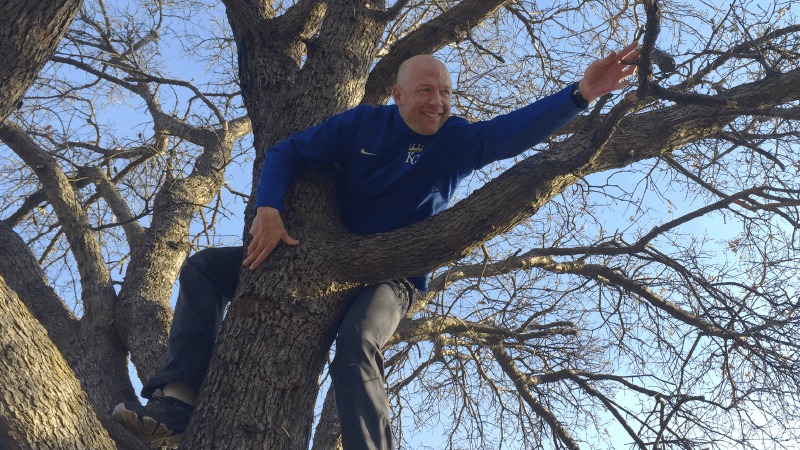
For many people, tree climbing is a childhood hobby that becomes less attractive as they grow older (and more risk averse). For me, (Rock Chalk) the opposite happened. I grew up in an area without big trees, and played games that kept my feet on the ground. As an adult, I discovered geocaching and the thrill of trying something new: tree climbing caches.
Continue reading →Author: Chris
Hopelessly addicted cacher and Geocaching HQ's public relations manager.
Inside Geocaching HQ Transcript (Episode 29): Lists
[music]
00:14 Chris Ronan: Hello everybody. Welcome to another episode of Inside Geocaching HQ, the podcast where we talk about stuff happening here at HQ in Seattle. I am Chris Ronan. My Geocaching user name is Rock Chalk. As always, thank you for downloading our podcast. On this episode, a return guest, Brendan Walsh from HQ’s product team. He is here to chat about a project that you might not see immediately, but you will definitely see it eventually. So we want you to know what’s coming. Some fun updates to list functionality on geocaching.com. I am personally pretty excited about what I’ve seen so far. I think you will be too. So here we go, me and Brendan talking Lists.
[music]
01:10 CR: Alright, well, Brendan, people are used to hearing you here on the podcast talking about the new Search and the new Map. We had you on a couple of times to talk about that. The next logical place to go is list, I think, and here you are talking about list. It is kind of a, a logical progression, isn’t it?
01:29 Brendan Walsh: It is, it is. In fact, in the mobile view, we have a nice little toggle to go from map to list, so it’s just a different visualization. If you’re looking at your caches plotted on a map, or in a list base. And thanks for having me back on, Chris. It’s always great to talk to the community. Yeah, so I’m a product manager here at HQ. And most recently, I worked on the Maps search project as you mentioned, and in that project, we run the web a lot, checking it out, of course, and really diving deep on the features that we are building for Map. We noticed we probably should give lists a little love as well. So, the same team of engineers that I worked on the Maps project with have been working on lists for the past three months or so, and we’re at a place where we’re really excited to share it with the community. We’re launching a new list hub and a new list details. And what that really means is a list hub is the visualization on the website of your list of lists.
02:31 CR: So when you go to the dashboard and it says your list, click there, that’s your list hub you go to.
02:36 BW: Exactly. The old or the existing, the one that the community is familiar with now, is very good at doing what it does, and we thought, “Okay, let’s take what has been done, the work there, and kind of take it to the next level. So we re-imagined the UI through a great work of one of our product designers here at HQ and now it looks a little more modern. We have all the controls for things you can do with a list, be it a copy or a map, or a download as GPX. Those are really obvious now and they’re not hidden behind another control or an overflow menu, so you can get to the stuff you wanna get to much quicker. If you’re on the list hub and one of your lists is maybe it’s a list you made for a Jasmer challenge you’re doing… You could click into that really easily and now you’re on the list detail page so it’s a similar view. But now, you’re seeing all the caches.
03:33 CR: And that’s a big change. The list, as I’ve looked at it, in testing, the list hub is very different. It’s exciting. It is as you said, much more accessible, even though the old one did a great job. The list details, though, it’s a big, big difference from what people were used to in the past.
03:53 BW: It’s a big difference. Thanks for calling that out. It’s gonna look a lot like or very similar to what the search results list looks like on our homepage, so you’re gonna have a list of caches, going left to right. The data… The data points we’re showing are different and more varied and more in-depth. Give you… Telling you more about the cache. If you’re logged in as yourself, Chris, and you’re looking at a list, it, be it my list, or one of your owns, where you have an indications that if you DNF’d it or if you found it, you’ll see right there the status of each cache, right? Backing up a little bit, if you’re on the list hub and you’re looking at that Chris’s favorite favorites in Washington that he’s gonna go after, we’ll tell you right there the progress you’ve made on that list. Now, it’s not always a competition, but it’s nice to know like, okay, if that list is 150 caches, you found 90 of them, and you only have this many left to go and it’s…
04:52 CR: I can’t tell you how many times I have clicked through to a list and I just scroll through it on the old version. Let’s say, I’ve got 100 caches in a list and I’ll scroll through, looking for ones that don’t have a smiley face next to them, and okay, I need to find four but it drives me crazy. Now, I’ve got this status bar that can tell me right away. Right.
05:11 BW: It tells you right upfront. Yeah, thank you. I’m glad that speaks to you guys, too. The other cool thing is, obviously, we have this multi-select control. So, this idea where I could maybe go to your profile or someone like mountain bikes who are these wonderful curators in the community building these lists that I may wanna take advantage of. So, go to your… As long as it’s public, I can go to your profile, make a copy of that list, and now I have that list too, right, and I can map it or make a subset of it.
05:44 BW: And we’re hearing from a lot of people that that is gonna be in our initial testing that that’s real pretty powerful to have access to other folks’ lists that have done the taste-making, the curation maybe ahead of time and you can reap the benefits of that. Maybe in the future, you’ll be one of those people to create lists and put them out there for others to share.
06:04 CR: We were talking about there are so many geocaching organizations out there that they maintain lists of popular caches in their areas, and to be able to go and copy those lists and then have them for yourself and, let’s say, I’m gonna be traveling somewhere and I look up an organization in… Oh, let’s say, Germany. I’m gonna go to Germany and I’m gonna… Oh, there’s this organization in this town and they’ve kept these great lists. Now I can just copy ’em, and when I go to that town, I can keep track of them on my own, which is really great.
06:35 BW: Yeah, it’s great. And I think there are other… This is sort of our first put for this new revamped, pardon me, list details and list hub. But I think as folks use lists more and perhaps share them, and we’re gonna encourage that sharing them within the community from user to user, sharing them and opening them on your mobile device, which is a great use case. It’s a little bit more friction now than we’d like so with this release, we’ll get closer to actually having a deep link right to that list details page, if you’re sharing it. So you can go from planning to caching pretty easily without a lot of copy, paste, open in this tab, and send to this friend. It’s just gonna be a lot more direct. Probably a good time to talk about how we’re gonna roll it out.
07:22 BW: We’re looking to get this new list project out beginning on September 5th. And we’re gonna start rolling it out in a slow and deliberate manner. In the past, we did a slow rollout with maps and we had quite a bit of learnings from that rollouts. And in this one, we are doing a lot of pre-release show and tell, if you will, with not only lackeys, but with some reviewers and a group we have called play testers, which are actual community members who are opted into this group, who get a first look at some things. And they’re giving us some feedback on it as well.
07:57 BW: So beginning on the 5th, we’ll start this rollout using a tool we have here at HQ that allows us to kind of put this out to a small percentage of users, new users, and assess feedback, see what they’re thinking about it, take that feedback in, and either make changes or not, depending on how it goes, and then continue to roll it out. And we’re looking at having the entire list, the new list experience out some time in the end of October of this year. So it’s very slow and deliberate. It’s our first time doing it quite like this. Some tech organizations call it a canary rollout, in the sense that, you put a little bit out there, and you get some feedback or some signals from that canary in the coal mine telling you how your release is going through the community. And then you can make decisions about whether you wanna roll it out faster or keep that same pace.
08:51 CR: Yeah, so if you’re hearing this right now and you’re not seeing it, you’re gonna see it eventually. It might take some time. There’s no way for somebody to come and ask for it. They just have to wait their turn, [chuckle] essentially.
09:02 BW: It would be difficult for us to scale that in terms of offering that to each individual member. The hope here is that by doing this slow, deliberate, rollout, we actually hit the market fit, meaning, we deliver what we expect the customer would want. So we’ve done lots of, some research and user testing, but we don’t really know until we put it out there. The other part is our focus on quality. We wanna make sure this is rock solid. So by putting it out slowly, our risk is minimized.
09:35 CR: There’s some great features to talk about here, but before we get into those, how does your team prioritize which features to tackle, and what to try to incorporate into both the hub and the list details? There’s all kinds of stuff you could do, but how do you decide what’s gonna go in there?
09:55 BW: That’s a good question. Well, the cool thing here about HQ is we have a community who’s really passionate and we have so much feedback. Product managers who were here before I even started working here have handed me oodles of notes and feedback on all things, not just lists, but specific to the lists project, what we did is we did a process I would call customer development. So really understanding your customers, the different types of customers that are out there. So, not everybody is the most experienced geocacher who might go out every day or every weekend, there’s different stripes of geocachers.
10:33 BW: So, trying to engage with all different types who represent sort of a different segment of the geocaching community, asking them what works, what doesn’t work, asking lackeys what works and what doesn’t work, using tools. Once we get through the initial design process when we feel like we have perhaps a new list hub that is interesting, we started testing that. So we use tools like user testing, where we crowdsource actual users who have geocaching accounts and they give us feedback. We rinse and repeat and on all that, and just try to get better as we go with taking in feedback and making changes to our designs or our code. And we get to a place where you’re never gonna have 100% certainty, but we have enough that we wanna share it with the community and we start getting real feedback and that’s when we go to production.
11:23 BW: In terms of, I think, at a higher level, prioritizing what we go build on or what we go build for each quarter, and stepping away from lists a little bit. It’s a combination of looking at what our company’s goals are for that year and what our mission statement is, and then what we can do as a team in the space that we work in, on the web, to go help go influence those goals, whatever they may be.
11:47 CR: Well, like I said, there’s a lot of interesting features here, and [chuckle] this being audio and not video, we can’t show them, but just some of the things that stood out to me is, especially on the… Well, let’s start with the list hub. As you said, it used to be that, well, on the current one that a lot of people might still be seeing when they listen to this, but eventually, when you get the new list hub, the stuff’s just more accessible. It used to be you would have to tap on that little dot, dot, dot. And now, stuff is more… There’s still a few things in there.
12:20 BW: There are.
12:21 CR: But what is the dot, dot, dot called? Is that a…
12:23 BW: Well, we call it an…
[laughter]
12:25 CR: Is it not the dot dot dot officially?
12:27 BW: We’re officially changing it to the dot dot dot. I think, officially, it’s been called the overflow menu, and then, anecdotally, it’s been called the meatball menu by…
12:38 CR: Meatball might be better than dot dot dot.
12:39 BW: Meatballs, if you haven’t had lunch, you you might not wanna call it that, but… That is where things have been basically resided. That’s more of a mobile design aspect as well. And because the mobile space, you have very little of it, you’re hiding not hiding, you’re storing lots of controls behind that panel. We have, in our new list hub and list details, we have what we’re calling an action bar, which is a horizontal bar that looks like a header. It sits on top of all the lists. If you’re on the list hub or all the caches, if you’re on details, now, across that bar are gonna be the various controls that you could do for the list, so you could map the list if you click that. You could copy the list. You could download it as GPX, you could change your privacy settings on it. You could turn on notifications you could create a pocket query. All the things you can do now they’re just represented differently. And you’re one click, excuse me, one click away as opposed to two or three.
13:43 CR: Right, right. And then once you choose a list and you’re in the list details, being able to sort those columns.
13:51 BW: That’s new.
13:52 CR: Totally new.
13:53 BW: That’s totally new.
13:53 CR: And a lot of different columns, stuff we didn’t see before. So things like favorite points and difficulty in terrain and it’s much more robust than it used to be.
14:04 BW: Yeah, thanks. And we… This came from the engineers. They’re looking at what the work we just did on the search results page, we’re showing that level of data and they’re coming to me and saying, “Hey, we have space on the page, let’s show more stuff. So that really came from within and that was great. Let’s show favorite points, especially on a page like Favorites, where don’t you wanna sort on favorite points to see. You gave that cache a favorite but wouldn’t it be interesting to see who else did? And it sort of almost a validation moment. Yeah, that cache really was great, it wasn’t just me. And now that we’re talking about favorites. One thing that’s very small, but I think it’s gonna be really helpful for everybody is right across the top, on list hub, we have what we call a segmented controller, so you’ll see it says my lists. So when you’re on list hub, it says my lists, and then going over one, it’s gonna say favorites, and you click there, you got your favorites view. And then a list that a lot of us may or may not use, or may not know about.
15:08 BW: We have a list called ignored caches. So you add a cache to this list, if you just want it out of the realm of your Geocaching experience. So if you went and searched on a location and you added that, you sorted by ignore list, you wouldn’t see the caches that are on that list. Those kind of things.
15:26 CR: I tend to forget it’s even there, because it’s right now, at the very bottom.
15:30 BW: It’s hard to find.
15:31 CR: Yeah, it’s at the very bottom and now it has a lot more visibility up there at the top, which is really good. Are there other things that new features and we could go on forever about some of the new stuff but is there anything else that is standing out to you heading into this?
15:46 BW: I think the one thing that is interesting is the ability to take giant lists, and make subsets of them and then within the… So, for instance, using the multi-control, you could take a list, let’s say, like 500, maybe it’s yours, for instance, I can copy it and just make a subset of it, of the 20 or so I need… And from there, I can also continue to add more geocaches. We built a nice little UI that you can engage with that you could put in the GC code if you know it.
16:14 BW: If you wanted to add a specific cache to your list or you could quickly go to the map, do a search, then add those caches to your list. So, it’s a start for sure. I’m really excited to get it out there. And like I said, the mantra I’ve been going with is collect. So collect the caches that you want in your planning stage, that you wanna go after, connect, so you could use the list as a way to connect with your friends by sharing it. It sort of could be the connective tissue within the game and then go caching, once you’ve done that work, you just… You’re consuming that list out in the field.
16:53 CR: Collect Connect Cache, that’s a t-shirt, right there.
16:57 BW: I like t-shirts.
16:58 CR: I know you do. Yeah, I wanna see that. We gotta see that t-shirt. Collect Connect Cache.
17:02 BW: Think of them… I think one of the inspirations too was playlists. So the way you would share a playlist with your friends, if you’re into music, could lists have the power to be something like that? And what if we made them really cool? And then, we’ll eventually be partnering with our marketing team to get the word out and start talking about these and hopefully, folks enjoy them as much as we had enjoyment building them.
17:28 CR: So September 5th, around then, this will start. It will continue up until early October. What’s your team doing during that time period as you’re pulling, as you’re gathering feedback, and what have you?
17:42 BW: Gotcha. We’re gathering feedback, for sure. We’re also doing our final polish passes. So, for instance, there’s too much white space here. We wanna change the pattern here, so like our last minute fit and finish on the actual look and feel, and any kind of bugs that reveal themselves through this process. We’ll be working on those. So like I said, we’ll be pretty much heads down on this into the September timeframe, and at which point, we liked at HQ here, we have what we call a warranty period. So after we ship something, the team that’s responsible for it is still all hands on deck for that initial 30 days. And then after that, we’ll be assessing our priorities for 2020 per the product and engineering direction and perhaps working on something else or perhaps, based on the feedback, adding more features to lists.
[music]
18:35 CR: That was Brendan Walsh, Senior Product Manager at Geocaching HQ. For more about lists, check out the Geocaching Help Center and the release notes section of the Geocaching forums. We will also have a blog post coming soon as the scaled roll-out proceeds. Got something you’d like to hear about on the podcast? Just drop us a line to podcast@geocaching.com. That is podcast@geocaching.com. And as always, thanks for listening. From me and my fellow lackeys at Geocaching HQ, happy caching.
Inside Geocaching HQ Transcript (Episode 28): Allison Kelsey
Listen to the episode here.
00:13 Chris Ronan: Hello everybody, welcome to Inside Geocaching HQ. I am Chris Ronan, my username is Rock Chalk, I am one of the lackeys who works at Geocaching HQ in Seattle. Today, I am excited to share a conversation with Allison Kelsey. She is the director of Product here at HQ. She will explain what that means as well as what the product team does, and how it shapes the tools that you use to go geocaching. So here is me and Allison talking Product.
Inside Geocaching HQ transcript (Episode 27): Is it legal?
[music]
00:13 Chris Ronan: Hey everyone, this is Inside Geocaching HQ, the podcast from Geocaching HQ in Seattle, I am Chris Ronan, you might know me by my user name, which is Rock Chalk. Thank you for having a listen to our podcast. On this episode another chance to get to know one of my fellow lackeys Jennifer Arterburn is the Vice President of Business and Legal Affairs here at HQ. She has a super interesting background and does the kind of work that you might not realize is necessary for a game like Geocaching. Hope you enjoy our talk, here we go.
[music]
00:56 CR: Well Jennifer, let’s just start by giving the quick overview about what your job description is here, your title and your job description here at HQ.
01:05 Jennifer Arterburn: My job has evolved quite a bit in the time that I’ve been here, but I started about seven years ago, and I came on really because Bryan Roth who is now our President and is also an attorney was really at a place where he was starting to take on more of an operational role and didn’t have as much time to do the legal work. So when I came on, I came on to do legal work strictly. And then my role has grown from there, to include managing HR, managing learning and development, as well as facilities. And the legal work has remained the same. But one of the wonderful things about working here is that it is really an incredible soup to nuts, legal practice, where I get to do a little bit of everything.
01:52 CR: Yeah, that… I don’t think a lot of people know that Bryan is an attorney and that that must be interesting, to have an opportunity like that. This isn’t a law firm, but the fact that there are two people that are attorneys you guys can I would imagine bounce a lot of stuff off each other and learn from each other and all that.
02:10 JA: That’s actually one of the wonderful things about working here is getting to have someone who I can bounce ideas off of. I used to work in a law firm environment. Of course, you’ve got lots of lawyers there where you can have regular conversations, bouncing ideas off of each other and talking through legal issues. And I think being here alone would be sort of a lonely existence as an attorney. So it’s wonderful to be able to go in and chat with Bryan, our offices are very close, and I can just connect with him and talk through things. And so that is really helpful for sure.
02:39 CR: You are known in some parts as Gia rather than Jennifer.
02:45 JA: Yes [chuckle]
02:46 CR: Gia Coyne would be your full on screen name.
02:47 JA: As of late yes. [chuckle]
02:49 CR: Yeah it’s your on screen names.
02:50 JA: It’s a very recent development, for me actually. Yeah, we, well, two of us here, we’re fortunate to have the experience to help out with Mystery at the Museum. And the Gia Coyne moniker was actually very off-the-cuff spur of the moment, we were trying to decide what my name should be and one of our wonderful crew came up with that name, and I think it’s a pretty good one.
03:20 CR: And you…
03:21 JA: I’m actually considering changing my user name.
03:23 CR: Well, that’s… I think people would enjoy that quite a bit.
03:26 JA: We’ll see.
03:27 CR: And you have great experience to help you with that Mystery at the Museum project before you were an attorney, you worked in television in broadcast news.
03:38 JA: That’s right, yeah, I started my career in TV news, and I worked in a few different markets, anchored Alaska, Las Vegas and then most recently the San Francisco Bay area, and I was there for five years or so. And then I started to just wanna do something different and I ended up going to law school at night, and finished law school and then started work in a law firm like a lot of attorneys do, and after a couple of different law firms and some in-house experience at the Smithsonian, I found the job here, and it has been bliss ever since.
04:15 CR: I also worked in broadcast news, and I know a lot of people go into different industries after working in there, most of them do what I did they end up in communications or something like that. You were much smarter than any of us and much smarter than any us [chuckle] by having the ability, but how does one end up in… How did that interest in law come about from… Or was it there before you worked in the news business?
04:41 JA: Yeah, no, one, let me just first say, I am not much smarter than most of us. You know what? I think that part of being a reporter, so much of it is reading, writing, asking questions, trying to understand things and those skills translate well into law. And so when I was trying to decide what to do next, I was thinking about either a business degree or a legal degree and ended up going the legal route almost purely by chance really. I just thought, “Well I’ll just give this a try.” I was still working in my day job as a reporter, started going to law school at night, and even going to law school, I wasn’t quite sure that I was going to stick with it.
05:18 JA: But once I got out and I started working, I really enjoyed it a lot and decided to keep with it. I mean, I feel like I was incredibly fortunate as I was moving out of news because it can be hard to make that transition to have gone through law school and then to come out of it with a job. It was at a time when the economy was actually doing pretty well, and so that worked out well for me and then years later to be looking to leave the law firm that I was at, and to have the opportunity at Geocaching come up was pretty incredible. I actually started… My first day here seven years ago was on Valentine’s Day and it seems like such an appropriate first day now to me because I was just in love with this place from the very beginning. When I came in here to interview, it was pajama day, I think, and everyone here was in their pajamas and coming from a law firm environment that was just such a quirky switch to me, I thought, “Wow, okay, I need to work somewhere like this.”
06:22 JA: I had geo-cached before I interviewed but I didn’t know about the game until I knew that I was coming in for an interview. And so then, on top of finding this amazing place to work, to learn about this game and to get to understand what an incredible community is associated with it, and how much joy it brings to people’s lives, it was such a winning combination I just, I had to be here. And so, Valentines Day seems to me to be the most appropriate work anniversary I could think of.
06:52 CR: Yeah, that’s great, and as you were talking about that it made me… I can remember one of my first days here, and I also came from a corporate environment, and one of the first days there was a game night after work and I remember seeing Bryan in the kitchen with a ping pong paddle stuck in his back pocket, and just thinking to myself, “Yeah, that wouldn’t have happened at my old company.” It really crystallized for me, this is a very different type of a place here.
07:20 JA: It’s a whole different world for sure and a wonderful one.
07:24 CR: Yeah, absolutely. Before I came to work here just as a geocacher, I think I would have been surprised if someone would have said, “Oh yes, there are a couple of attorneys who work at Geocaching HQ.” Because I think, “It’s a fun game. What need is there for legal affairs?”
[laughter]
07:40 JA: Yes, it is a fun game. You know what I would say is that, and I talked a little bit about the fact that my experience here is very broad, the breadth of legal work that I get to do is, it really covers everything. I do contract review work for our partnerships and promotions, travel and tourism. I get to also help to structure the way that we handle privacy issues here. The general data protection regulation, which went into effect in Europe last year, has had a big impact on us. Obviously, we always wanna be taking care with our users’ data and be very mindful of how much data we’re collecting, how we use it, how long we keep it. In addition to that, things that a lot of people don’t even bother to read like the terms of use and our privacy policy, consume a lot of my time.
08:30 CR: Yeah I’ll bet you, are you a person that when you download an app or register for a website, most of us click past that stuff. I would imagine you’re someone that gives it a little bit stronger of a look than maybe the average person.
08:43 JA: I do sometimes give it a look. I will say one of the things that I know about it, like everyone knows, is that if I want to use this app or whatever this service is I’m probably gonna have to agree to it. I’m not gonna start negotiating [chuckle] with Facebook about how I use their app. And so, I’m pretty quick, generally, to just accept as well, but I might do a little bit closer look just to see what other companies are doing.
09:09 CR: But certainly with the… We’ve got one just like they do, our terms of use and so forth, and that’s something that you and Bryan keep a close eye on and occasionally will make updates to that.
09:21 JA: Yeah, we’ll certainly be making an update, probably toward the latter part of this year to accommodate some changes in California’s law. There’s a new law going into effect January 1; the California Consumer Privacy Act. So we’ll be updating our privacy policy and our terms of use some time later in the fall, for sure.
09:40 CR: Using that as an example, and I would imagine it’s similar with other projects that you briefly mentioned in that overview, when something like the European privacy stuff comes up, I would expect that there’s a process where you need to learn about it and then also try to find out, “How does this apply to our business?” And then also, “How do we execute the changes that need to be made?” I would certainly think it’s very involved, but how do you go about learning about this stuff, and then eventually working your way through making the necessary adjustments that need to be made?
10:21 JA: Yeah. Fortunately, there is a lot of legal education available and there are certain associations that you can belong to that give you access to that education. A lot of law firms also put out various alerts and articles that are very helpful in terms of just initial research. And then we also rely on outside counsel a lot, especially in Europe, where I’m certainly no European law expert. And so, experts in Europe are really who we go to when we have questions.
10:52 CR: You mentioned Human Resources briefly there at the outset and that’s another part of your role here. We had Eileen on the podcast not long ago.
11:01 JA: Oh yeah. That’s right.
11:02 CR: And she talked a bit about getting a job at HQ and some of the great things about working here. But what are some of the responsibilities that come along with that for you?
11:11 JA: Yeah. Well, so I am, let’s see, I’ve been managing HR now for probably five years, I wanna say. In my role I get to have a hand in determining what our culture here is like, and part of that can be, who do we bring in? Who are our new employees? And I should mention that we actually have a number of openings right now, including Front-end Developer, React Native Developer, Senior Systems Administrator. And so, if you or someone you know happens to be skilled in one of those areas, or in one of our other openings, we’d certainly love it if you applied. But that piece, the hiring piece, is really key to determining what our culture looks like; that and also, how do we treat our employees? How do we talk to each other? We’ve worked really hard to make sure that we’re having honest conversations with each other, and to make sure that when we are setting expectations that we’re very clear about them and really communication is key to all of that. And so, that almost brings it full circle back to my background, which is in communications, really in essence, as a journalist. And so, getting to play the role of both legal, HR, they really do fit together into that background as a journalist.
12:37 CR: So how about geocaching? You’ve now been here, what, about seven years? You’ve gotten to do a lot of geocaching over the years. What are your favorite kinds of caches to go after? What do you enjoy most about the game?
12:49 JA: I think in seven years, I have done a lot of really cool caches. The one that probably stands out the most to me, and the one that really, I think, gave me a sense of wonder about the game is one that I did not long after I started here. And it was, I guess what I would call a gadget cache. It involved tools and, yeah, it just blew my mind really. I was like, “I can’t believe that somebody put something like this together and put it out in the world for people to find.” So I’ve enjoyed the gadget caches that I’ve done. But really, I have two young children, and patience is often at a minimum. And so, we typically do traditional caches. Often, I like to do them when we’re on a hike, and I use them as incentive, “Oh hey, there’s a geocache up ahead. Let’s keep going, just a little bit farther.” And it works more often than not, and so those… Generally, I’m a weekend cacher and typically traditionals. Every now and then I’ll do something a little bit more complicated. But I tend to like to do those with other adults.
13:55 CR: And you’re going to a big event here not too… Well, later this fall, right?
14:00 JA: Yeah.
14:00 CR: People’ll have a chance to see you if they would like, down in Georgia.
14:04 JA: I sure am. I’m really excited to be going caching. It will be my first major, domestic mega event other than the block parties that we’ve held here. And so, I’m really excited about it. With young kids, I really didn’t travel much the first five years that I was here. I just didn’t feel like I could get away. And now that my kids are growing up, I feel like I can start to travel more. And so I’m really excited to get down to Rome.
[music]
14:29 CR: That was Jennifer Arterburn, aka Gia Coyne, Vice President of Business and Legal Affairs at Geocaching HQ, and Lead Anchor on HQ TV. If you attend the Going Caching Mega Event in Rome, Georgia, be sure to say hello to her. And as she mentioned, we have a number of current openings at HQ. So go to geocaching.com/careers to learn more. If you’ve got an idea for the podcast, send me an email to podcast@geocaching.com. In the meantime, from me and from Gia, and from everyone at Geocaching HQ, happy caching.
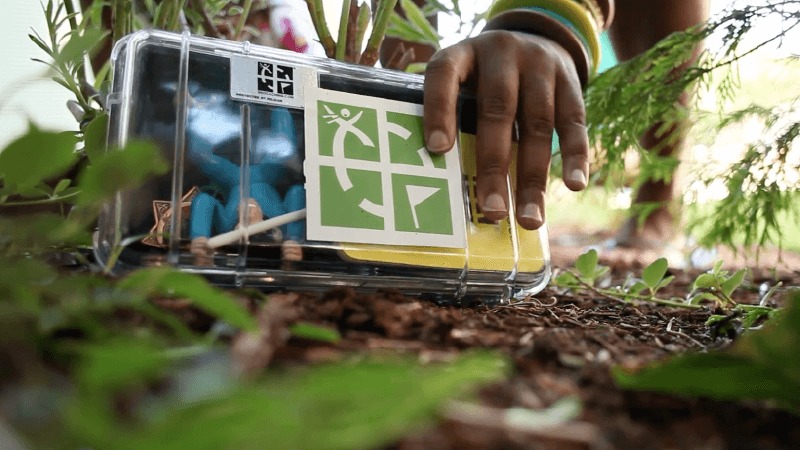
Geocaching Etiquette 201: Cache-eigenaarschap
In het eerste deel van deze tweedelige serie deelden we een aantal tips die door Geocaching HQ en vrijwillige reviewers worden gegeven, als er gevraagd wordt naar het vinden en loggen van caches. In dit tweede deel bespreken we de tips die we geven over de etiquette voor cache-eigenaars.