Geocaching.com Presents: Favorites

[This video contains spoilers with express permission from cache owners]

[vsw id=”AhuX7N8b3xw” source=”youtube” width=”425″ height=”344″ autoplay=”no”]

Watch the Geocaching.com Presents: Favorites video above to explore how geocachers use Favorite Points to find and reward amazing geocaches. Geocaching Favorites was introduced in December of 2010. The feature allows Premium Members to award Favorite Points to the caches they enjoyed most. Everyone can see how many points a cache has received.  Since Favorites was added to the Geocaching.com website, more than 2.6 million Favorite Points have been awarded.

Some geocachers award Favorite points to historic caches like The Original Stash Tribute Plaque. The location that records the placement of the first geocache ever has accumulated more than 900 Favorite Points. Creative and unique caches with spectacular stories also earn Favorite Points. Geist des Hagen, a clever geocache about a ghost who haunts the woods of Germany, has earned more than 1000 Favorite points.

Premium Members earn one Favorite Point for each ten caches found. You can then award to an exceptional cache in your find history. For every ten caches that you find, you earn one Favorite to award to an exceptional cache in your find history. Basic Members also benefit by seeing how many Favorites a cache has earned in search results and on the individual cache pages.

A geocacher from Maryland, United States says, “as a community we benefit by seeing more and more caches that have creative camouflage, and fantastic locations that we might not have visited, and that’s really what the sports all about!”  Watch the Geocaching.com Presents: Favorites video to find out more and see how you can discover and learn from amazing geocaches through Favorites.

The next Geocaching.com Presents video showcases a difficulty five, terrain five geocache in Germany known as The Rock. It has more than 300 Favorite points. The Rock is scheduled for release on November 3rd. Geocaching.com will continue to release English, Czech and German language geocaching videos in the coming months. Subscribe to our YouTube channel to be one of the first to see new videos. Watch the more than 50 videos produced by Geocaching.com on our video page.


Geocaching Finds Its Way To the Classroom

By: Kara Bonilla

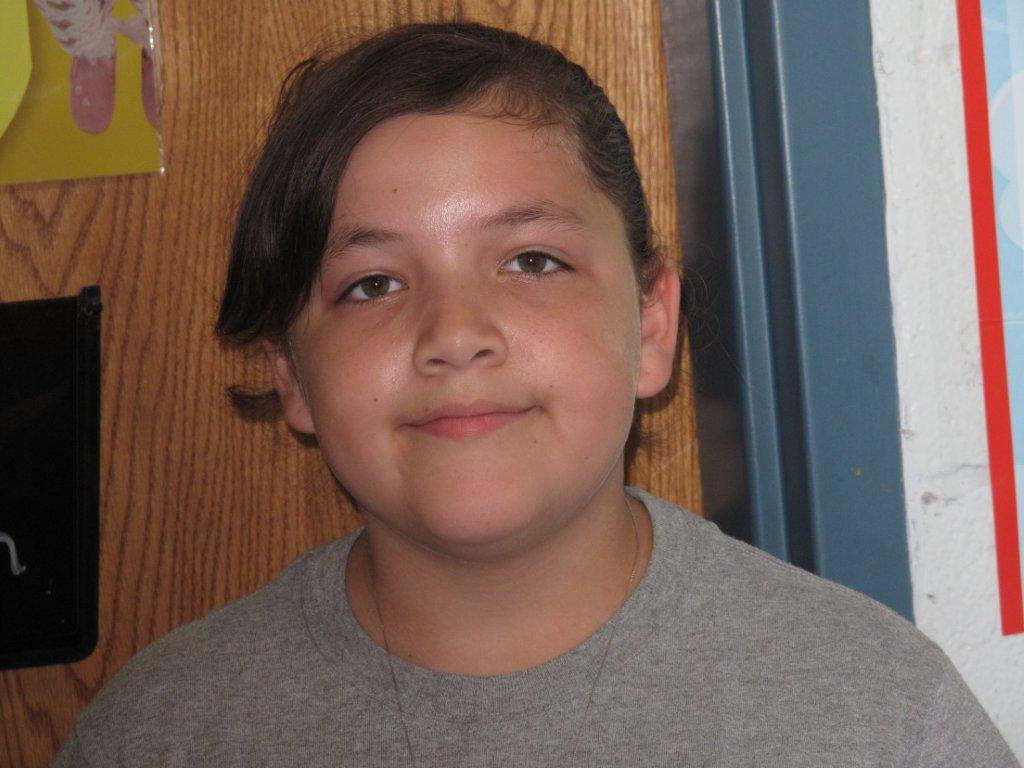
West Mercer Elementary Students geocaching

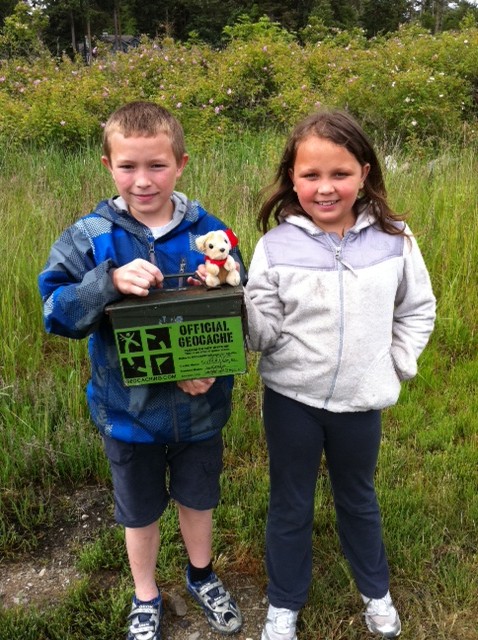
Teachers for all grade levels have begun to use the location-based treasure hunting adventure of geocaching as a teaching tool. Teachers say students learning through geocaching enjoy benefits far beyond learning outside of a classroom setting; geocaching makes learning more enjoyable and creates unforgettable learning opportunities for students.

Ellis Reyes, a fifth grade teacher at West Mercer Elementary in Washington, USA, has been using geocaching in the classroom for the past two years. He integrates the activity into several subjects.

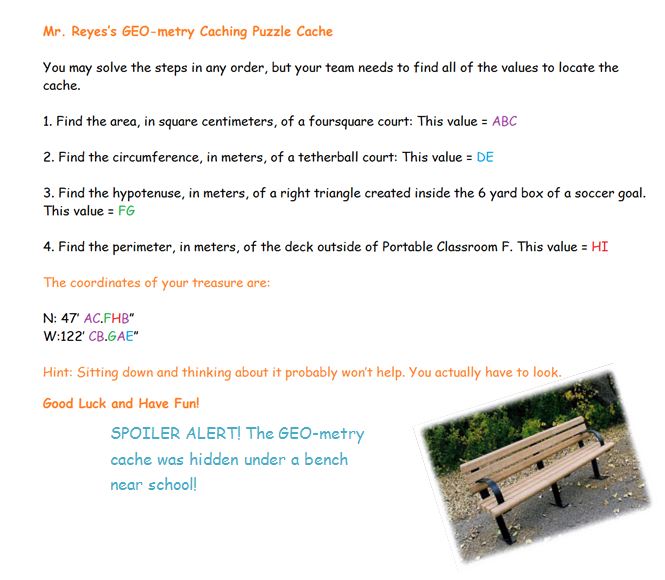
Ellis hides different types of geocaches for his students to find on campus and in nearby local parks. One of his favorite ways to utilize geocaching involves using multi-step puzzle caches to teach math. Ellis calls this “GEO-metry Caching.”

A lesson involving geocaching in Ellis’s classroom tasks students to use several sets of skills, especially problem solving and advanced math skills.

Ellis says the students are excited to explore geocaching in school, “The kids love using geocaching to learn. It’s about solving puzzles and creative thinking, and getting out of the classroom, what’s better than that?”

With other subjects, such as language arts, Trackables come in handy for Ellis’ class. The students drop their own Trackables in geocaches close to school. They then follow each Trackable’s movements as a class. Ellis has each student create a background story for their personal Trackable. When the Trackable makes a stop, Ellis has his students add more to the story. Soon, the students develop a narrative about the Trackables journey.

Students develop the required skills in the curriculum and learn critical thinking and spatial concepts with the combination of geocaching and additional lesson planning.

A "GEO-metry" lesson plan from Ellis Reyes

Fourth grade teacher Eva La Mar has had a portion of her classes dedicated to teaching geocaching for the past eight years. At Riverbend Elementary in Oregon, USA, Eva teaches the various tools students need to go geocaching, including directional knowledge, the concepts of latitude and longitude and how GPS signals work.

“I love the sport, the exercise, the thinking that is involved.  Seeing students motivated and connecting with learning is what education is all about.  This is real-life learning.”

Eva also incorporates geocaching into other fourth grade studies. Geology being a fourth grade topic, EarthCaches fit perfectly into her lesson plan. Through EarthCaching and other variations of geocaching, studying the Oregon Trail becomes very real to students. The geocaches students find as a class show the many stops along the trail, helping them understand the concept of “trail-blazing.” Eva’s students love geocaching so much, she says, that most of them have turned geocaching into a family affair. This last year, Eva held a geocaching field trip that both students and parents attended.

Use of geocaching as a teaching tool has become very popular. There are already books and web pages dedicated to geocaching and education, making it easy for teachers to integrate geocaching into their classrooms.

Groundspeak is actively working on a project to create easier ways for all teachers to use geocaching in their classrooms and to share their experiences and work with other educators. There’s even a geocaching guidebook for teachers.

Watch this video of students learning through geocaching:

[youtube]8jVS_vDLHec[/youtube]


Refer a Friend – Help Kids Learn about GPS

Karla

This is Karla. She is a student at a low income elementary school in Texas and a member of the after-school technology club, Tech-Click.

In 2009, Groundspeak was able to provide three GPS devices to Karla’s club through DonorsChoose.org. DonorsChoose.org is an online charity that connects teachers with donors to fulfill classroom needs.

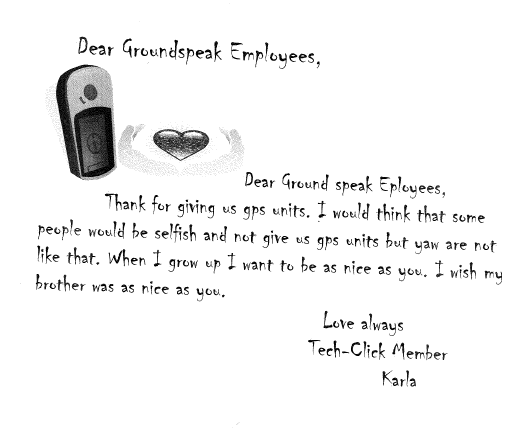
These three GPS devices allowed Karla and others in her club to learn about latitude, longitude, spatial concepts and more. Karla sent us this letter to thank us for the donation:

Now, you can help others like Karla learn about GPS technology simply by telling people about geocaching. From June 1- 30, 2011, for each new member that you refer to Geocaching.com, we’ll donate $1 to DonorsChoose.org.

How it works:

  1. You introduce someone new to geocaching. You can take them out on the trail with you, send them our new “tell a friend” email, write a blog or simply shout about it from the rooftops.
  2. The person that you introduced to geocaching signs up for an account (Basic or Premium) between June 1 and June 30 and fills out the “referred by” field on the account creation page. (Make sure to give them your Geocaching.com username so that they can fill out this field.)
  3. He or she logs at least one geocache between June 1 and June 30.
  4. We give US $1 to GPS-related projects on DonorsChoose.org.


The more people you refer, the more money we can donate to classrooms in need, up to a total of $10,000 USD!

Teach your friends about geocaching and help provide students like Karla with the tools they need to have engaging learning experiences.

We will be providing regular updates on the number of referrals here on Latitude 47 and on Facebook. Thank you for helping!

We also wish our brother was as nice as you.

Cheers,

The Groundspeak Lackeys


Trackable Etiquette

Trackable Etiquette

Trackables

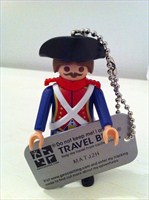
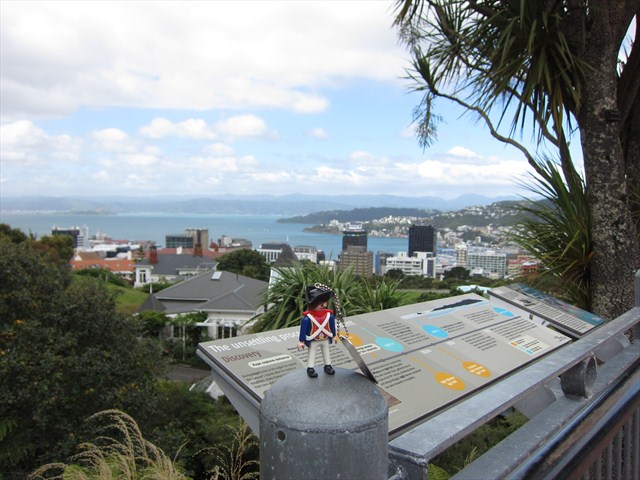
Trackables are “game pieces” that add another level of fun to geocaching. Trackable owners generally assign them goals such as to “cross the Atlantic” or “visit 5/5 geocaches.” The geocaching community helps Trackables reach their goals by moving them from cache to cache.
How do you know when you have found a Trackable?

Although Trackables come in many shapes and sizes, each one has a tracking code—a unique series of letters and numbers—stamped on it.  This code allows geocachers to follow the items’ real-world travels online. A Trackable will also contain text indicating that it can be tracked on Geocaching.com or Groundspeak.com. The most common Trackables are Geocoins and Travel Bugs®.

If you find a Trackable in a geocache, you are not required to trade anything for it, but please take it only if you are willing to follow some general Trackable etiquette:

Trackable

•    Log that you have retrieved the Trackable from the geocache as soon as you can. This way the Trackable owner, cache owner, and anyone who may be searching for the Trackable knows that it is moving.

•    Check the Trackable’s goal by inputting its tracking code here before placing it in another cache. The idea is to place it in a cache that will move it closer to its goal.

•    Drop the Trackable in the next geocache and log that you have done so. If you need to keep the Trackable for more than two weeks, please email the Trackable owner to inform them.

Remember that Trackables are owned by other members of the community who are eager to see where their Trackable moves next. Before you take an item from a geocache, please check to see whether it is a Trackable and, if it is, only take it if you are willing to help it on its journey in a timely manner.

Learn how to log a Geocoin or Travel Bug or buy your own Trackable at Shop Geocaching.

Trackables sindSpielsteine‘” welche einen zusätzlichen Spaßfaktor zum Geocaching hinzufügen. Die Besitzer von Trackables legen im Allgemeinen Ziele wieÜberquere den AtlantikoderBesuche nur 5/5 Geocachesfest. Die GeocachingCommunity hilft dabei diese Ziele zu erreichen, in dem Sie Trackables von Cache zu Cache transportiert.
Woher weißt Du, daß Du einen Trackable gefunden hast?

Obwohl Trackables in vielen Formen und Größen vorkommen, hat jeder einen TrackingCode eine eindeutige Folge von Buchstaben und Zahlen eingestanzt.  Dieser Code ermöglicht Geocachern, die Reisen dieser Gegenstände online zu verfolgen. Auf dem Trackable befindet sich auch ein kleiner Hinweistext, dass er auf Geocaching.com oder Groundspeak.com verfolgt werden kann. Die häufigsten Trackables sind Geocoins und Travel Bugs®.

Wenn Du einen Trackable in einem Geocache findest, ist es nicht notwendig, wenn Du Ihn herausnimmst etwas als Ersatz hineinzulegen. Du solltest jedoch folgende TrackableEtikette beachten:

    Wenn Du einen Trackable aus einem Geocache entnimmst, so logge dies bitte so schnell wie möglich. Dadurch weiß der TrackableOwner, der CacheOwner und jeder der nach diesem Trackable sucht, dass dieser sich bewegt hat.

    Überprüfe das Ziel des Trackables wenn du seinen Code hier eingibst, bevor du Ihn in einen anderen Cache ablegst. Die Grundidee ist, dass Du den Trackable in einen Cache legst, welcher Ihn näher an sein Ziel bringt.

    Lege den Trackable in den nächsten Geocache und logge dies online. Wenn es nötig ist, dass Du einen Trackable länger als zwei Wochen behältst, melde dies bitte dem TrackableOwner.

Geocoin

Denke daran, Trackables sind Eigentum von anderen Mitgliedern der GeocachingGemeinschaft, welche gerne sehen wie sich Ihr Trackable weiter bewegt. Bevor Du einen Trackable aus einem Geocache entnimmst, überprüfe daher bitte, ob Du ihm beim Erfüllen seines Zieles helfen kannst.

Erfahre wie man einen Geocoin oder Travel Bug® loggt oder kaufe Deinen eigenen Trackable im GeocachingShop.

ADDITIONAL TRACKABLE STORIES:

Zusätzliche Trackable Geschichten:

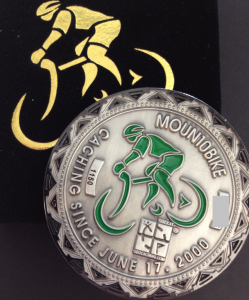
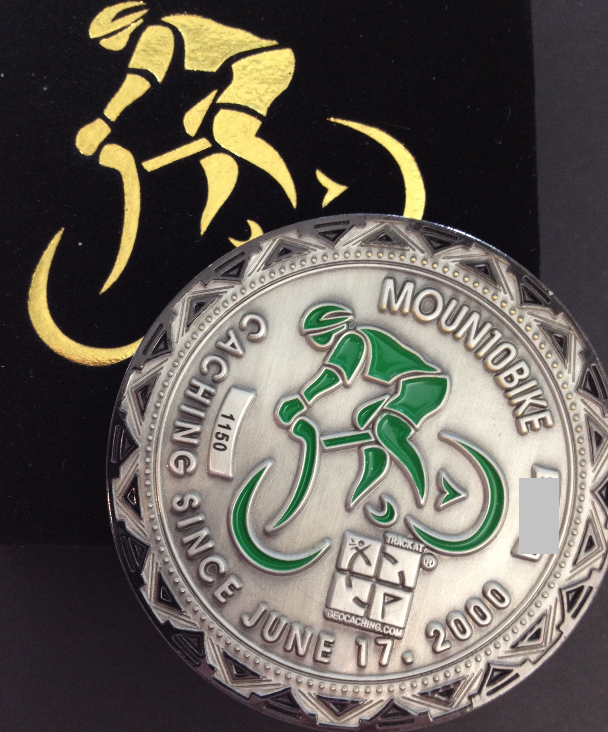
Share your Trackable stories for a chance to win this rare and coveted Moun10bike Trackable.

Share your Trackable stories for a chance to win Trackables.

Teile jetzt Deine TrackableGeschichten mit anderen und habe die Chance auf diesem seltenen und begehrten Moun10Bike Trackable.

Shop Now to Find Trackable Week Discounts of 10% or More
Finde jetzt Rabatte von 10% oder mehr während der Trackable-Woche
(Für Trackables von teilnehmenden Anbietern)

Add Your Tips to the Geocaching “Rules of Thumb”

Opa&PK

Geocachers Opa&PK recently sent a letter to Groundspeak Headquarters titled, “Opa’s Rules of Thumb for Caching.”  The rules embody lessons learned over years of geocaching. The team has been geocaching since 2003 and has found more than 2000 caches.

Opa taught geocaching classes with another geocacher, Lynn from “QuantumFarms.”  The experience helped Opa develop the rules you’re about to read.

Opa says, “I do think they could be used as a teaching tool for ‘newbies.’ Even though tongue-in-cheek, every one has a practical application as well.”

Here’s ten of the rules that they discovered on the geocaching trail:

1- No matter how much advance research you do, the cache will be on the other side.

2- Any references to water/swamps/mosquitoes/tics in a cache’s description or log entries should be believed.

3- Always take the official bushwhacking distance and multiply by 3.62.

Opa, packing spare batteries, at the Original Cache

4- Waterproof footwear isn’t waterproof — unless the water is already inside.

5- You are allergic to some form of plant life; you just don’t know which one yet.

6- Always carry spare batteries, always.

7- If something looks out of place for the locale, it could be the cache.

8- If something looks absolutely authentic for the locale, it could be the cache.

9- Sometimes you have to just trust the instruments; at other times go with your experience and instinct.  The trick is figuring out which approach to use for THIS cache.

10- Excessive coffee drinking does not go well with caching.

There are many more rules out there. Post a comment. What rules of thumb would you add?