Get your cameras rolling—the Geocaching International Film Festival is back for its third and final year. Over the past two years, geocachers have sent in films telling stories of adventure, love, FTFs, DNFs and things we can’t even begin to describe. So what’s next? That’s up to you. Help us send off GIFF with a bang by submitting the most creative video ever.
When you go to find your next geocache it’s not uncommon that you’ll step on, over or near a benchmark. There are over 700,000 benchmarks in the United States alone. And you know what? You can log them on Geocaching.com.
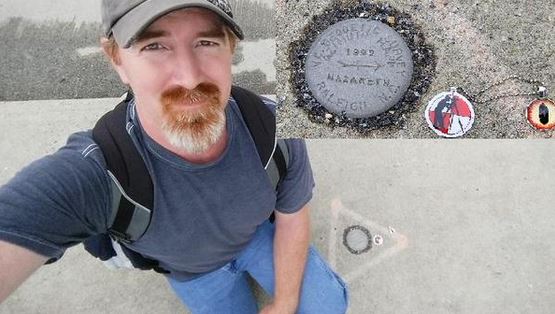
Benchmarking, also known as benchmark hunting, is a hobby in which explorers find benchmarks aka survey markers or geodetic control points. Hunting for geodetic markers is a fun and challenging activity just like geocaching. If you haven’t tried benchmarking, now is your chance! The National Council of Examiners for Engineering and Surveying (NCEES) is hosting a contest encouraging geocachers in the United States to take a photo with the official NCEES Trackable at a benchmark and upload it to social media using the hashtag #PSnoboundaries. Photo submissions will be automatically entered to win a trip to the 2015 Geocaching Block Party in Seattle, Washington. Official contest rules can be found here.
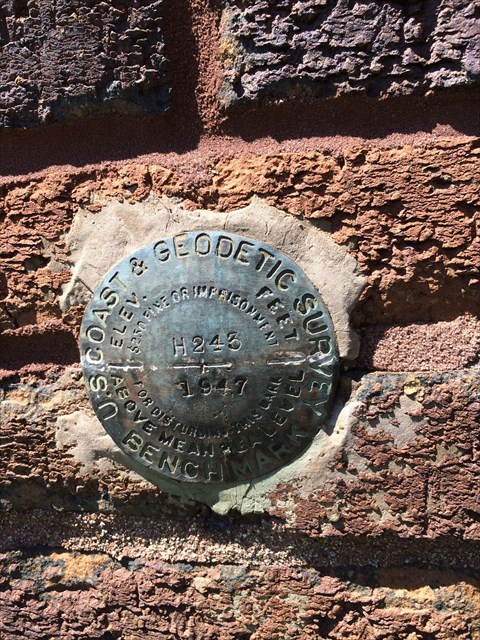
Benchmarks can be found at the top of peaks or in a village square, and you’ve probably walked by at least one without even knowing it! The most common survey marks are cast metal disks with a stamped legend on their face, set in rock ledges, sunken into the tops of concrete pillars, or affixed on the tops of pipes that have been sunk into the ground.
Long time geocacher and new benchmark enthusiast Cammy aka “Cammy7” tells her story of hunting for one of her first benchmark finds, KW0802.
“I took the trackable to KW0802, Columbia E. Base located on the Wrightsville Bridge in Columbia, Pa. While photographing this benchmark, a man was walking across the bridge and asked what we were doing. I explained benchmarking and the contest to him. He then told me he had something I needed to see at his bookstore. The bookstore is located within walking distance just off the bridge on the Columbia side of the river. My mom and I followed him to his bookstore where he showed me a spot on the front step where a benchmark was located. He explained how he found the benchmark inside the store when he bought the old building. He called NGS and got information about the disk. It was reported missing in 1956. The bookstore was originally a general store.
KW0802 on the Wrightsville bridge is a triangulation station disk and a reference point is JV4845, Susquehannock. JV4845 is located at the top of the Turkey Hill Nature Preserve Trail along the Susquehannock river. Geocache GC1QAP3 “TAKE A HIKE!~Look-out Turkeys!” is located at the benchmark. The benchmark is a concrete marker with a brass cap used to attach survey equipment. The view of the Susquehanna river is beautiful with the Wrightsville bridge in view.” – Cammy7
Geocachers across the United States are embracing the challenge to hunt down a benchmark and upload a photo to win the ultimate prize, even if that means running away from bears in Alaska!
SCARLY <3Rellimer13 shared her story with us: “Finding benchmarks was new for me. If it weren’t for the contest I might not have even discovered that I could log benchmark finds on the website! Just like before I went geocaching for the first time, I did as much online research online the night before as my eyes could tolerate. The different types of markers/way points, how to look for them.. I was nervous to go out and look without coords, I didn’t want to come up empty handed before releasing the traveler again. Each benchmark on the geocaching website was spot on though, and I had a really successful 24 hours of hunting before handing over the tag to a fellow cacher! It’s cool how old some of those NGS descriptions are, and they are still relevant! Amazing. The first one I found at night because usually I prefer caching in the cover of darkness anyway! But I completely spaced out what time of year it was, and when I found the cache that was near the benchmark I was searching for, it had been chomped on by a very hungry bear that must have just come out of hibernation. I was very spooked (I had no form of protection! I didn’t think they were awake yet..) I got out of the woods ASAP! And continued my benchmark quest the next day, in broad day light 🙂” –SCARLY<3Rellimer13
Whether it’s in the woods, near a monument, or on the sidewalk near your home, there is a benchmark waiting to be found….and potentially a prize to be won!
Over the next few months, we’ll all be going on a geocaching journey to celebrate 15 years of geocaching. You’ll have the opportunity to complete five geocaching quests, each of which will earn you a special souvenir for your geocaching profile. Complete all five and you’ll earn a sixth, extra special souvenir.
After each quest begins, you’ll be able to complete it and earn your souvenir until September 2, 2015. So pack your bag, load up on snacks and set your road trip playlist, because here are your quests and their start dates:
June 19 – Sept 2: Find a geocache with 10 or more Favorite Points
July 3 – Sept 2: Attend an Event, Mega-Event or Giga-Event
July 17 – Sept 2: Find a T5 or D5 geocache
July 31 – Sept 2: Find an EarthCache or attend a CITO
August 14 – Sept 2: Find a Mystery Cache
Before you begin…
No road trip is complete without a trusty co-pilot. Sign up below and we’ll remind you when each new quest is launched. We’ll also send you helpful hints and tips for this fantastic voyage.
Every road tripper needs a trusty co-pilot.
Sign up for your Geocaching Road Trip ’15 co-pilot!
Du hast Deinen ersten Geocache versteckt. Und wie geht es weiter?
Geschafft! Du hast den coolsten, kreativsten Geocache aller Zeiten versteckt und alle Richtlinien eingehalten, nicht wahr? Na, damit endet der Spaß aber noch nicht. Als Geocache-Owner bist Du verantwortlich dafür, Deinen Geocache zu warten und kontinuierlich zu betreuen. Deswegen ist das Verstecken bloß der Anfang Deiner Karriere als Geocache-Owner.
Lies diese 9 Tipps zur kontinuierlichen Betreuung des coolsten und kreativsten Geocaches aller Zeiten. Um weitere Informationen darüber zu erhalten, wie man einen Geocache versteckt oder ein Event veranstaltet, schau Dir die neue Seite dazu an. Danach nimm an diesem Quiz teil, um Dein Fachwissen zu testen.