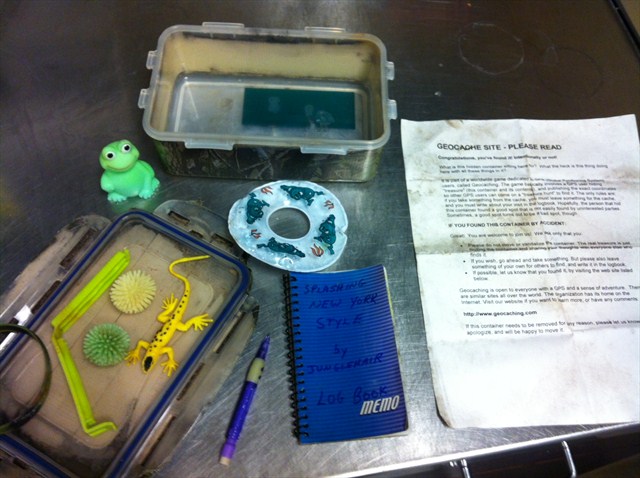
One of the first rules of geocaching involves the matchbox cars, the bouncy balls and the lady bug erasers staring up at you from the bottom of the geocache. That’s geocaching SWAG – or Stuff We All Get. Geocachers trade swag by replacing items in the geocache with something of equal or greater value.
Now you can spread geocaching joy by leaving a trail of customized, do-it-yourself swag in geocaches. Geocachers often leave signature items in each geocache they find. The customswag might be a signed playing card, a crocheted finger puppet, identical erasers or __________ (insert your amazing idea here). Each piece is a sign to other geocachers that you visited the geocache. It’s a great way to build community. Leave a recognizable piece of swag and you will become known by yourswag. Think of it, you could be “Origami Guy” or “Ladybug Lady” or ___________ (‘Insert your amazing idea’ Person”).
Share your ideas for personalized geocaching swag below in comments or on the Geocaching Facebook page.
This holiday season one Geocaching gift will smile back at you as it travels the world, heck it might even wave. It’s the poseable and adorable trackable LEGO™ geocacher. Each LEGO™ geocaching adventurer features the Geocaching logo and a unique tracking code.
Launch the geocaching game piece on a mission to explore as it bounces from geocache to geocache and track the entire journey on Geocaching.com. It might even be tempted to take a trip the most favorited geocache in Germany, near LEGOLAND® Berlin.
The trackable LEGO™ geocacher is one of dozens of holiday gift ideas available for U.S. orders through Shop Geocaching and orders outside through U.S. through our International Retailers.
1,000 geocachers volunteered to be part of the first ever major study of geocaching and its effect on health. The 14-month Texas A&M study called Geocaching for Exercise and Activity Research (GEAR) launched in January of 2013. The first set of results from the study were presented on November 5 at the annual meeting of the American Public Health Association in Boston.
Each of the participants were given devices to track their movement and a logbook to record their level of geocaching intensity. The first results showed the effects of regular geocaching. Researcher Whitney says, “The GEAR study has identified an association between geocaching and improved health.”
Another researcher, Garney, goes on to say, “GEAR participants who report geocaching once a week or more are more likely to meet national guidelines for physical activity and are more likely to report good or very good health status compared to those who geocache less frequently.” In addition, research showed that geocachers reported fewer days of poor physical and mental health compared to state level data.
Follow Geocaching on Instagram for more epic and inspirational geocaching pics http://instagram.com/gogeocaching
These findings are still preliminary, but nevertheless we’re excited about them. The study concludes in early 2014 and final data will be analyzed and presented later that year.
The health benefits of geocaching are often the subject of emails to Geocaching HQ. Have you lost weight geocaching or sharpened your mental skills? Share your stories about improving your health through geocaching in the comments below.
Geocache found after 3 years after washing away in a flood
Isn’t a wet logbook the worst? Or maybe a geocache filled with water is the worst? Or a geocache that isn’t well-marked might be the worst? Or maybe even a geocache that can’t be found because it’s washed away by a flood is actually, really, the worst. Well then Sandra, aka junglehair‘s, geocache is the antidote to all those “worsts.”
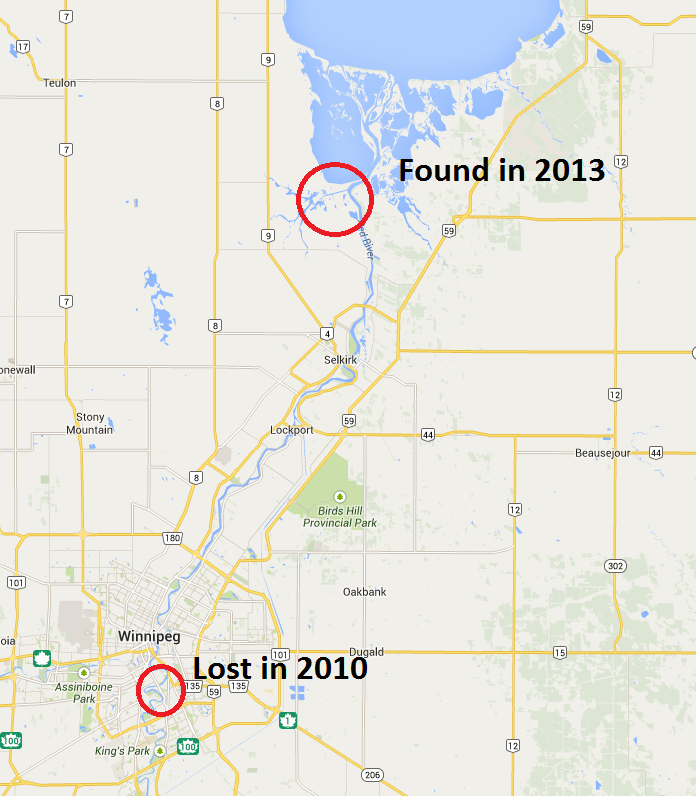
She’s found more than 13,000 geocaches and hidden more than 70. She knows her geocaching stuff. Sandra’s knowledge includes using the right container for the right circumstances. They’re containers that are durable and last years. She says those containers are most importantly water-tight. None of that seemed to matter much though when a spring flood washed through Manitoba, Canada in 2010. Even though her geocache named Splashing New York Style was hidden high on the bank of a river, it was swept away. After a string of DNF (Did Not Find) logs, she replaced the geocache container.
Lost & Found
Then the years rolled by, until an email popped into Sandra’s inbox. She says, “I found out that one of my caches that was washed away in a spring flood in 2010, was found on an island about 60 km North of where it was originally hidden.” The story goes, “The cache was found by Rob Bruce, Marsh Manager at Oak Hammock Marsh while he was on a hunting trip in Netley Marsh. He had been camping on the island where the cache was found.”
Sandra says the geocache survived those three years intact and water tight. It was well marked so Rob knew the container was a geocache and he also knew how to contact the geocache owner. The geocache just bobbed along for years before finding a resting place on an Island on the south end of Lake Winnipeg.
Sandra says, “The really amazing part of this story is that the log book and other contents of this cache were still fairly dry inside! It was hidden in a Lock & Lock container (the real kind, not a dollar store knock off).”
It’s a Lost & Found lesson about quality, well-marked, water-tight containers. It’s also a lesson about luck. It helped that it ended up in the hands of a friend who geocaches, a lot. OHMIC returned the geocache, but he happens to mostly find them with more than 15,000 finds.
What are your tips, advice, techniques, tools… well you get it… for placing a durable, water-tight, well-marked geocache?