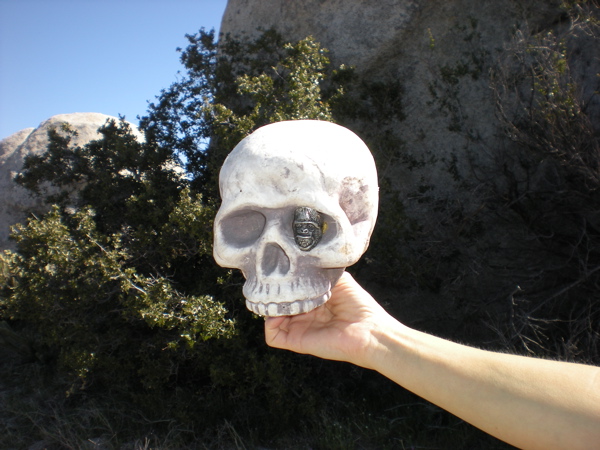

Geocaching Evolution – The Themed Multi-Cache

FBZ A.P.E. 51; Stone of the Lost Valley
Near a FBZ cache

The geocaching spectrum runs from the ease of drive-up light pole caches all the way into the dark world of mind-bending themed Multi-Caches.  The geocaches like the “Forbidden Zone Geocaches” (FBZ) around San Diego, California push geocachers to their mental and physical extremes.

It took two years for Jim Epler (SGTF) to create the complex and conspiracy-laden series of seven geocaches.

Jim says FBZ draws inspiration from the Project A.P.E. caches.

Seven caches are hidden in and around San Diego.  The story line for the FBZ geocaches has players assume the role of an agent investigating a link between extraterrestrials and primates, and possibly uncovering plans for an alien invasion.
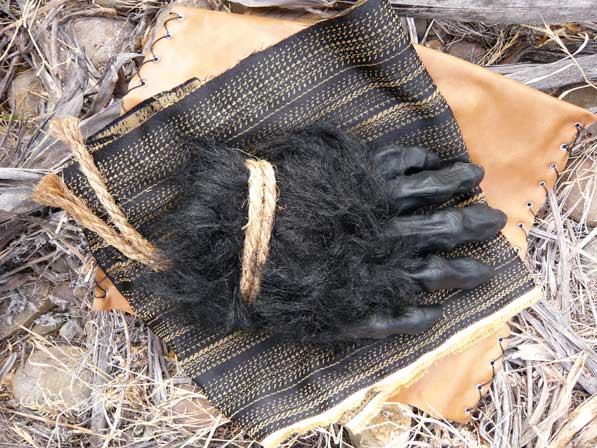
FBZ Clue/Prop (No animals were harmed in the making of this cache)

Clues and passwords at each cache advance players through the game.  The players must register through the Forbidden Zone Geocache website. The registration is only to keep score.  All the geocaches are available through Geocaching.com.  The first six geocaches do not have to be found in any particular order to uncover coordinates for the final cache.

When asked why he created such an involved geocache, Jim jokingly says, “because I didn’t know any better!”

But he says creating the Multi-Cache was two years well spent: “For me, the fun was in the creative process, not necessarily the end result. I looked at it as an enjoyable hobby which comprises a number of things I like to do including web site development, photography and graphics design, research, prop building, science fiction, storytelling, urban exploration, and hiking.”

The caches were hidden in 2008. More than a dozen geocachers have attempted the series and many completed all seven caches.

FBZ Clue

Jim hopes that people finish the cache without absorbing too much of the conspiracy.  He says, “I hope visitors are able to appreciate the ‘tongue and cheek’ humor which was my foundation for the entire project. I wrote the ‘top secret’ documents from the perspective of a paranoid conspiracy theorist, and all the stuff used to support this ridiculous storyline is just one long outrageous spoof.”

What do you think, would you ever attempt a themed Multi-Cache? Have you encountered other caches like this?
“The Geocaching Triad” Geocaching.com’s Lost & Found Video

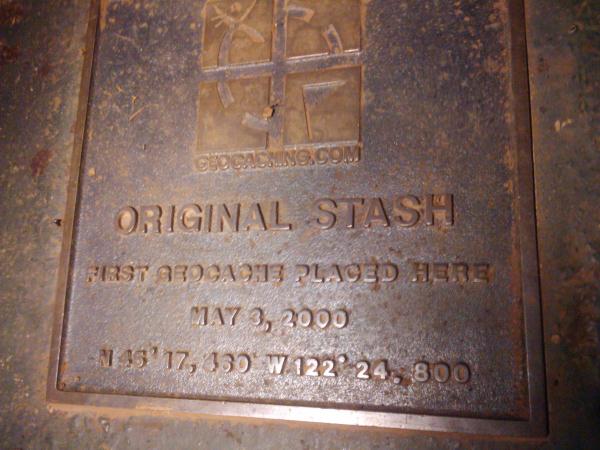
The Original Stash plaque

This video follows Ohio, USA geocachers Keith Lemons (keithlemons) and Nancy Steyer (27jack) as they visit the three caches required to complete the Triad.  Beware, the video containers spoilers.

The Triad is one of the crowning achievements of geocaching. Geocachers must log three specific geocaches: the APE Cache Mission 9: Tunnel of Light, Groundspeak Headquarters and the Original Stash Cache. Each find is rich in geocaching tradition. The geocaches do not need to be logged in any particular order.

The Original Stash Tribute Plaque hides outside of Portland, Oregon.  The plaque there commemorates the placement of the first geocache in 2000.

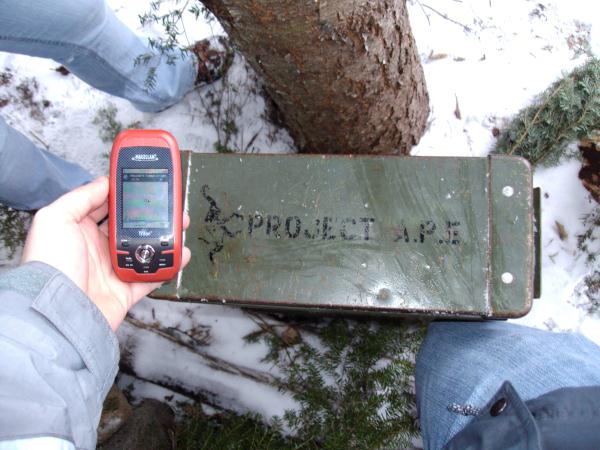
Project APE cache

Geocachers  must also log The Mission 9: Tunnel of Light Project APE Cache, hidden outside of Seattle, WA. Twelve APE caches were originally placed around the world in 2001 to generate publicity for the remake of the movie Planet of the Apes. Mission 9: Tunnel of Light is one of only two APE caches still active in the world.  The other, Mission 4: Southern Bowl is in Brazil.

The geocache at Groundspeak HQ

Geocachers need to also visit the geocache at Groundspeak Headquarters.  Groundspeak HQ is also known as the Lily Pad.  It is home to the offices of Geocaching.com.

Geocachers who complete The Triad says the accomplishment not only earns them  personal satisfaction and but also bragging rights.

Have you ever completed The Triad?  Do you have plans to do so?

“Richard Garriott’s Haunted Geocache” Geocaching.com’s Lost & Found Video

Geocaching pioneer and video game designer Richard Garriott, aka Lord British, pushes the envelope again with the creation of the Mystery Cache Necropolis of Britannia Manor III (GC2B034).

A resident at Necropolis of Britannia Manor III

The journey leads geocachers through what Lord British describes as eight chapters on “The Guardian’s Quest.”

Part of the graveyard at Necropolis of Britannia Manor III

The first seven chapters are waypoints or benchmarks.  The chapters are a twisted maze of cryptic clues and mind-bending puzzles.  Solving each chapter provides a clues to find and unlock the geocache at the end of the final chapter.

The treasure hunters that reach the final chapter will find a geocache with all too realistic professional movie props and haunted house techniques.  It took months to plan and build.

Garriott holds the record for the highest and lowest geocaches in existence.  Garriott rode aboard a Russian rocket to place a geocache aboard the International Space Station (GC1BE91) in 2008.  He also placed a geocache, Rainbow Hydrothermal Vents (GCG822), 2300 meters below the surface of the ocean far off the coast of Portugal in 2002. You can view a Lost & Found video about Lord British’s highest and lowest geocaches.

Lost & Found videos explore the fascinating adventure geocaching.  View more than a dozen stories, including one about an Army Sgt. who credits geocaching with helping keep him safe.

Who’s Hiding in Your GPS Device?

Who's in your GPS device?

Your GPS device is hiding a cast of tens of thousands. Every time your GPS device blinks to life, pioneers, innovators and at least one Chinese explorer blink back.  The journey to help you walk out your front door and find a geocache begins way back in 1400.

There were clearly no GPS devices then. Magnetized needles were used to find direction for more than a thousand years. But it wasn’t until the 14th century that an admiral in China put the innovation to another use.  Zheng He is reported to be the first person to use the compass as a navigational aid. The Chinese explorer and diplomat employed the compass to direct ocean expeditions to the South and West of China beginning in 1405.

Chinese magnetic compass (pbs.org)

Over the next two hundred years others, including Galileo and Amerigo Vespucci, the namesake of America, further researched navigating by latitude and longitude. But there was still far to go.

It wasn’t until the 1884 the International Meridian Conference adopted a universal Prime Meridian – or zero point of longitude.

Less than a hundred years later, in the 1970’s, a constellation of GPS satellites was launched into orbit.  They provided never-before-realized navigation accuracy to the U.S. military.  The rest of us began enjoying that accuracy on May 2nd, 2000 when the order was issued to stop intentionally degrading the GPS signal available to the public. GPS accuracy instantly improved tenfold.

One day later the first geocache was placed.

Think of the scientists, politicians and navigational crusaders behind the ideas of navigating by latitude and longitude.  Every time you power up your GPS their ideas boot up too. There’s a lot going on inside your GPS.

In addition to all those innovators, don’t forget the 40-some Lackeys at Groundspeak, 200-some volunteer Reviewers and four to five million other geocachers who drive this activity.   Each of these people and events make your geocaching adventure a reality.

Now don’t you want to put them all to the test and go grab a geocache?

The Reverse Geocaching Puzzle Box – Geocaching.com’s Lost & Found Video

Inventor Mikal Hart shifts geocaching in reverse.  Hart’s “Reverse Geocaching Puzzle Box” is a locked box that needs you to deliver it to a secret location.  The box won’t unlock until you take it to this pre-programmed destination.

The GPS-enabled box presents users with a deceivingly simple button and a small display.  You press the button and the display reads a distance. Players only have 50 chances to move the box to the correct location before the box locks forever.

There are many more geocaching adventures. Take a look at all the Lost & Found videos here.