[music]
Chris Ronan: Ahoy mateys! And that is the last you will hear of my pirate voice. This is Inside Geocaching HQ. Welcome. I’m Chris Ronan, your host for the podcast. We are busy with the Lost Treasure of Mary Hyde. Hope you have been enjoying the challenges this summer. Later in the show we will hear from Audrey Kettler from the marketing department at Geocaching HQ, who will tell us how the Mary Hyde story came about. Also in this episode, Magnus from project-gc.com, a very popular geocaching website. One of our great API partners. Someday we’ll do a show where we just talk about the API program, but for now, we will chat with Magnus, who is the founder of Project GC. But first, Jayme Hewitt. Jayme works on the product team at Geocaching HQ. Right now she is working on a very visible project, the updated dashboard. That is where you see a list of your recently viewed caches, your latest logs, you link off to your souvenirs, all sorts of important stuff. And they are approaching this project in a new way, so we thought it would be interesting to have Jayme tell us all about that. Here is me and Jayme talking about the dashboard and other fun stuff.
[music]
CR: Okay, so Jayme, you’ve been here for how many years at HQ?
Jayme Hewitt: Four.
CR: And how did you start here in the first place?
JH: I started on the community and volunteer side of things and was hired as a community manager. Half that, half volunteer team. I supported the worldwide crew of community volunteers while answering some tickets in a queue, and I moved from there over to the product side of things.
CR: And you were a geocacher before you came here?
JH: I was. I started caching with my husband Ben in 2008.
CR: You started here on the community team and you’ve done a few things over the years, right? Until you are where you are now, so what kind of work have you done leading into this role that you are currently inhabitating?
JH: Yeah, so on the community side of things I answered questions from people writing in. Concerns, reported bugs, took feature requests, etcetera, etcetera from people writing in. I worked in the forums for a while. I worked with the volunteers and helped triage problems that they were having working with a volunteer team. I became User Insights Analyst when I moved over to the product team. That was a move that… It started in my head when I was on the community team, because I really wanted to report these bugs and these feature requests and these things I was hearing to people and at that point in time, we didn’t really have a great feedback loop setup.
JH: And so, I didn’t really know where to give these things to to people, and I felt horrible saying like, “Yeah, great, I’ll report your stuff.” And there was nobody to take it. I, at that point in time, said, “Hey, can we start a feedback loop? I would love to be the person to do it.” I was given the role of User Insight Analyst and my charge was to get feedback from the general community and bring it into product development meetings. That was my start on the product team. After that, I transitioned into the role of Product Manager.
CR: And so, yeah, it’s been a natural progression, I guess, to where you are now. And so what is your title now? And what is your job description? What’s your general day-to-day duties are like?
JH: My title is Product Manager. I work on the product team, but then I also work with a delivery team. A team of engineers and a UX designer to make the stuff that the product team prioritizes and says, “These are the things that we should be working on.” My two separate teams are… The product team is a team of product managers, that also have delivery teams of their own. It’s like Ben, that you’ve heard from before in this podcast, is a product manager for the mobile team. I’m a web team product manager. My delivery team works on website features and stories. That’s kind of what I do. So as a product manager we are taking bugs and feature requests and business needs and we are prioritizing them as to what the community is looking for, based on what the business needs, based on the development resources that we have available at the time, and we’re taking all those thoughts and smushing them together and saying, “Okay, what’s the highest impact thing that we should be working on right now? What’s gonna make the most impact for the users and for Geocaching HQ?” And that’s how we decide the work to do as a product team, and then that goes to each of the web delivery teams. We have three separate web delivery teams. Each of them are working on separate features, separate bugs, from each other and that’s how we make the work happen.
CR: We’ve had Nadja on the podcast, we’ve had Ben, so they are both working on different delivery teams, correct?
JH: Completely different. Yep, yep, yep. And I’m working on different delivery team than Nadia. Her team is focused on very specific different features and our team has been focused on the dashboard.
CR: Which is a great segue into why I thought it would be really interesting to have you on the podcast is that each team does things a little bit differently in terms of how you decide how to attack these different projects, and your team has, as you said, has been working on the dashboard project. Could you talk about how you guys decided to do the dashboard the way that you have? Because it has been different and it’s, I think at times, been scary for some of the community. It’s been exciting for some. And I think if people understand a little bit more behind how you all decided to do it this way, and what the benefits have been, and what maybe you’ve learned during the process, I think that’d be really helpful for folks.
JH: Yeah, sure. It started pretty organically. My dev lead that I work with, Dave, he said, “Hey. Can we try something different this time with this big project?” And I said, “Okay. What are you thinking?”
CR: And different from what? The traditional way of doing it?
JH: Correct. Different from the way we have developed things in the past which is, we’ve researched big huge chunk of research before we started a project. And then we think we know all the answers from our research, so we create it in the way that we think will help serve the general community, and then we release it. Done. Usually a few follow ups in the end. Dave wanted to try something different. He said, “Hey. Can we release something that’s kinda bare bones, and get it in people hands first to see how they use it, and listen to feedback, and what they want to do with it, and then iterate really fast.” Listen to their feedback, do a release. Listen to their feedback, do a release. We have actually been doing releases almost every day, every other day, based on feedback that we hear from people in the forums, people on our feedback tool called Hot Jar. That’s kind of a different plan than typically what we’ve been doing at HQ.
JH: At first, we were a little bit worried with releasing something really bare bones to the community, thinking like, “They’re gonna think that we released this thing and we’re done.” Because that’s what we usually do, and we were worried about that at first. And so we wanted to be really proactive in the forums and say like, “Woah, woah, woah. We’re not done. We promise you, we’re gonna listen to you. We’re gonna listen to your feedback. We’re gonna be looking at data. We’re gonna be looking at quantitative results, and qualitative results to see what people are needing, what people are missing. We’re gonna be watching how people use this.” And we truly have tried to respect the feedback and listen to the feedback and see what problems people are having so we can help try and solve those problems on the go. Not having a fully released product, but keep adding value to it as the summer goes on.
CR: What are some examples of, maybe things that people have noticed of the ways that you’ve changed or made tweaks and additions based on that feedback?
JH: Yeah. The first one was a super, super big deal within the first couple weeks we released it. But we initially elected to remove email functionality from the profile and have everything go through message center. And we found out really quickly that didn’t work for a lot of people. We have changed our minds on that and brought back email functionality for everybody through the profile and said, “Okay. That’s fine. We won’t do that.” [chuckle]
JH: Another change that we switched out after listening to feedback was the about tab on the profile. People have statistics that they really love to display there. One of our concerns initially was that not everybody has that filled out, and so it was a confusing experience for people who didn’t have anything there. And we heard really strong opinions from people who did have stuff there, that they’re really proud of their stats and, “Please. Please. Make that the default landing page for the profile,” so we did switch that back eventually too.
CR: I know somebody’s probably out there right now, they’re listening and they’re saying, “But I still want them to change this, or this, or this. And they haven’t changed it yet.” Two questions, one… The first question, if somebody sees… They still see things that they feel really need to be changed. First question, how can they make their feelings known? Second question, does there come a time when it’s done? Or how long does this process go on for?
JH: Yeah, yeah. We do have bookends. We have planned bookends in our head and on our team. We’re aware of all the changes we want to make on the page before it’s done. We’ve kind of defined what our bookends are for completion, and we’ll let everybody know when we’re finished. [chuckle] We’re not gonna stop talking in the forums. The other question was… Oh, if people have changes they still… Continue to leave feedback for us on that little green widget guy down in your… I think it’s now on the center side of that page. We read all that. We’re paying attention to if you’re loving it or hating it. We also respond in the forums. If you go to the forums, every single release, Chris writes user release notes for the forums, for the release. We follow those and we pay attention to those and we’re listening to feedback. One thing that we have been hearing that we haven’t addressed yet, is the map link. We hear a lot of that on Hot Jar, so I can address that if you want me to now.
CR: Sure.
JH: When we first began this project, there was initially supposed to be some changes in the header to bring more visibility to the map link and the search link on the play drop down of the header, which is visible on every single page of the website. One of our reasonings for removing it from the dashboard was that it felt redundant if that was in the play drop down menu. Although at that point in time, it wasn’t super easy to see ’cause the text was… It wasn’t very clear. What we’ve done is we’ve made some changes, or we will be making some changes, to the header very soon that will make it incredibly clear, and the play drop down menu map will be the very first thing you see when you do that. Search will be the very next thing you see.
JH: There’s gonna be little icons next to each of them, so they’re gonna be very clear to say like, “Oh, this is the map. I can get to the map from any page on the site. I don’t have to click to my dashboard to go to the map.” We wanted to make it even easier than taking you to your dashboard to take you to the map. We wanted you to access the map from anywhere. That change was supposed to happen at the same time or before the dashboard ever got released. We ran into a few problems where we had some shortages in developers in the company and that project fell behind. We’re almost done with it though, so you’ll be noticing some changes in the header soon that should hopefully make it easier for you to access the map.
CR: And so with the project like the dashboard you can still use the old…
JH: You can.
CR: Way of doing it for the time being?
JH: It’s opt in. Yep.
CR: And at some point. But you can switch back and forth, right? If you decide… I’ve seen some people who are worried that if they switch over, they can’t go back and it’s an easy thing to go back and forth and check it out and see how things are changing over time.
JH: Yep, yeah. Please go check it out if you haven’t seen it from May, when we first released it. There’s a lot of changes that have happened since then. We’ve reduced the white space, which was another feedback complaint we had from people.
CR: We could do a whole episode on white space, you know?
[laughter]
JH: White space. Yeah, yeah. Definitely.
[chuckle]
CR: The pros and cons of white space. Yes, we could do that.
JH: Yeah, yeah. No, we’ve tried to reduce some of that because we know that scrolling is a pain in the butt for a lot people. And we have pretty big screens here, so it’s easy for us to see a lot on our screens which we need to remember to test it out on smaller screens, and check and make sure that we don’t require too much scrolling for everybody. We’re trying to ease that a little bit.
CR: Well, I’ll let you get back to making iterations.
JH: Thanks Chris.
[laughter]
CR: Thank you.
[music]
CR: That was Jayme Hewitt from the product team at Geocaching HQ. Hope you enjoyed our talk. Earlier this year, I spent a lovely week in Sweden and Denmark, and on one of those days, I had the great pleasure of geocaching with Magnus, the founder of Project GC. He showed me around some of the great caches in his city, and we took the opportunity to record a short conversation about his website. I did not have any of our usual equipment with me, so this was recorded on my phone, in Magnus’s cache-mobile, but it was a very interesting talk. Hope you enjoy.
[music]
JH: Magnus, maybe we could start, for people that don’t understand what Project GC is, could you just talk about what it is? What the website does?
Magnus: Absolutely. It’s actually several things today but from beginning it was all about statistics more or less. It started for me as a hobby project, more or less for my own purposes, but from that it has expanded, and over the years it has built into a successful site that is used by quite a lot of geocachers. The focus from beginning was, as I mentioned, statistics, and we tried to show in geocaching in numbers, in many different ways. Who has found the most caches? Who has found the most large caches? Who has logged caches most days in a row? And stuff like that. It would build a lot on let people have goals and wants to do something else but just finding caches. Trying to, yeah, have their own goals, push them a bit. Pretty much what it started like.
CR: What was the impetus in the beginning? What made you say, “I’m gonna start with this”? Was there something in particular that brought this to life to begin with?
Magnus: Yeah. Actually, it was a request from another geocacher, which is quite fun. We wanted to know who has logged the most caches, how Sweden was doing compared to other countries and so on. And not that it’s about the numbers, not really, but some people it drives. It drives me a bit. And not typical having those finds, but I like logging different details, for example. Or I want to know how many earth caches have I logged compared to someone else, and stuff like that. It was someone else’s idea from the start and I thought it was fun. I had some spare time. I was quite interested. I started building on this. Well, today it’s really not only about statistics but on Project GC, you can find almost any statistics you want, and they are dynamically created, so you can filter them on many, many attributes.
CR: I think a lot of people hear about Project GC because they do something with challenge caches, and they see checkers out there. How did the checker idea first come about?
Magnus: Yeah. You could call it one of the latest big things at Project GC. The thing was that I saw personally so many challenges that was so hard to figure out if you could log or not. And in some cases, the description was very hard to understand but once you understood that, it was fairly easy. But in other cases, it was very hard to look at your data to know, “Have I logged a GC code that starts with six and have I logged a mystery that hadn’t been logged for years before that,” and things like that. Actually, this started as something I needed myself as well. I am very into challenge caches myself. I’ve logged quite a lot. I’m up in a four digit number. And a lot of those has required me to build small programs, to actually produce some output of proof of how I fulfill it.
Magnus: And I felt like others will need these as well, obviously. From that it scaled to that I started building some form of framework where others, other users at Project GC, could create checkers. And from this it went into a moratorium, which you probably know, where Geocaching HQ didn’t allow anymore challenges to be published for about a year. And during this year we had some discussions between Project GC and geocaching.com and it ended up with the decision to require challenge checkers in a cooperation between the two companies. And since then we have improved it a bit, opened up, and today all new challenges that are published requires a challenge checker at Project GC. And it’s an excellent thing. It’s pretty much a click or two to know if you’re qualified or not.
CR: And for people who maybe know Project GC mostly because of challenge checkers, is there anything that you would like people to know about that they can do on your website that maybe they might not know about? Any features that you think people would enjoy trying out?
Magnus: For my own purposes, or my own favorite thing, is that I use it as a planning tool. When I started geocaching seven years ago, I pretty much was aiming to cache them all. I guess it’s quite typical, but suddenly you see that there are so many geocaches and I started traveling more, which meant that I was covering grounds of 100,000 geocaches. For me it wasn’t reasonable to log them all anymore. Especially since there are quite a few published everyday. Which is fun, but what I wanted to do was I wanted to be selective. I wanted to, as I mentioned, to log different details for example.
Magnus: When I was away to New Zealand, I wanted to find all the large caches, so Project GC created a tool that we call the Virtual GPS. We like to compare it to a shopping cart, more or less. While browsing Project GC, you can go through different top lists or can compare your finds with someone else, see caches and maps. Meanwhile, every time you see a cache, you can add it into this Virtual GPS. Pretty much like you add a T-shirt into shopping cart on another site. And once you feel that you’re done, you can export that Virtual GPS into GPX file and import into your geocaching program or Garmin GPS and that is, in my opinion, one of the most powerful tools at Project GC.
[music]
CR: If you haven’t already, head over to Project GC to check out those tools that Magnus talked about. That is project-gc.com. Okay, the Lost Treasure of Mary Hyde. We are into week three of the summer geocaching promotion. I thought it’d be nice to sit down with Audrey, from HQ’s marketing team, and hear more about how we came to know of the Lost Treasure of Mary Hyde. Here we go.
[music]
CR: We welcome Audrey to the Inside Geocaching HQ podcast. Audrey, is this your first podcast ever, anywhere?
Audrey Kettler: First podcast ever.
CR: In your whole life?
AK: Anywhere in my whole life.
CR: This is a world debut.
AK: Yeah, this is a big moment for me.
CR: This is huge. Wow. I had no idea that there was that kind of a…
AK: Yeah, the pressure is on.
CR: This is great.
AK: I can’t wait.
CR: Okay, so I have a lot of questions I didn’t tell you I was gonna ask you. A lot of crazy, controversial stuff that we’re gonna be talking about.
AK: Let’s just dive in.
CR: Let’s just get into it, right? First, before we get to the controversial issues, let’s talk about what you do at Geocaching HQ. You’re on the marketing team. What kind of stuff keeps you busy everyday?
AK: Yeah, so essentially I am on the marketing team and I’ve been with HQ for about two years. Our team really likes to say that we guide and form and inspire our community.
CR: This summer we have this Mary Hyde pirates promotion. In general, the summer promotions now has been going on, I think we counted, that this is the fifth year that we’ve been having these. How far in advance does the marketing team start thinking about what a summer promotion might look like?
AK: We typically like to think about it a few months before we would announce a summer promotion, so mid-March we like to have an idea of what goes on because there is a lot of planning that goes into the process. Whether it’s from the creative team, or the developers, the assets that we need, or just some data requests that go into it. There’s a lot that goes into any souvenir moment that we have at Geocaching.
CR: These promotions, there are people from all over the company that are involved in something like this. It’s not just marketing. It’s not just another department. It really does cross throughout people all throughout the company.
AK: Yeah, absolutely. Just to even start with an idea like this we usually sit as a marketing team, we start thinking of ideas, and kind of what we want to achieve. And typically that’s just creating something fun for the community to really just get outside and go geocaching and whatever that means. We usually start by thinking of an idea, and this year for our pirate promotion, we actually thought of the idea randomly in a meeting back in December. And once we thought about it, we’re like, “We know we wanna do pirates.” And really we wanted to do it because it brings geocaching back to the basics. And geocaching in itself is the world’s largest treasure hunt, so we knew what fits that theme better than pirates? And it seems like it’s really stuck so far and people seem to like it.
AK: But when we start with an idea, we bring it together, and then right after that we usually bring it to our creative studio. These are the people who are gonna be making all of the art for a promotion like this. And right now, we have a team of two, Roxxy Goetz and Nathan Cavanagh, and we brought this idea to them, and they just ate it up. And usually when they love it, their artwork is inspired and it just really transforms and takes off. They actually thought of the whole narrative. Roxxy, our designer, actually had a pirate themed wedding, so she has just been… She’s so knowledgeable in all the pirate facts and just different terms, so she’s been a huge part of this promotion. But beyond that, we work with our developer teams, and sometimes for some of our promotions we have features that are either on geocaching.com or sometimes could be integrated with our mobile app, so we had a lot of work with some of our development teams to make sure that we had use of the Friend League, specifically for this pirate promotion.
CR: One thing I didn’t mention before we started this was that we were going to conduct the rest of the segment in our pirate voices. That won’t be a problem, will it?
AK: No.
[laughter]
CR: Are you serious? Was that really your pirate voice?
AK: Argh!
CR: Oh my gosh!
[laughter]
CR: Yeah, we’re not gonna do that.
AK: Yeah, that’s bad.
CR: For people who aren’t familiar with this summer’s promotion, it is the Lost Treasure of Mary Hyde, and what all does it entail?
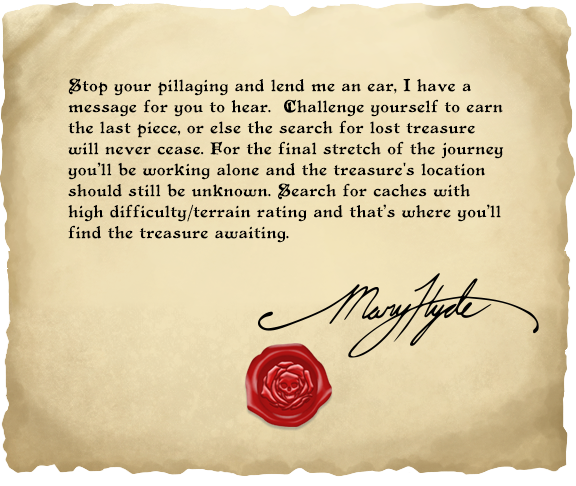
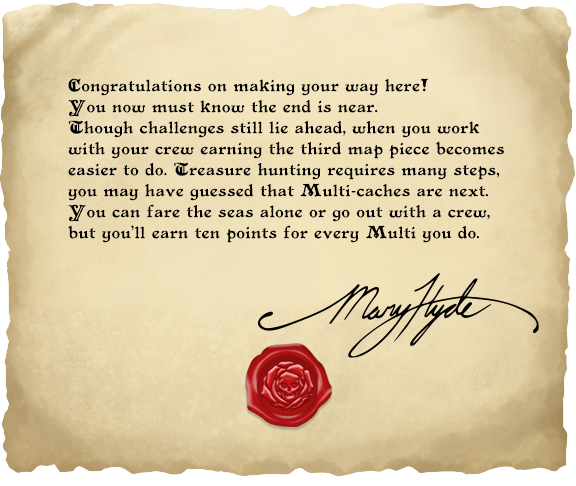
AK: Yeah, so this is a four week long promotion with new challenges each week. Each week there will be a new souvenir up for grabs. Using the Friend League, you’ll see what points you need to earn, whether that’s a team challenge or an individual challenge, and once you earn the points, you will be awarded that week’s souvenir, which will be a map piece. Once you earn all four map pieces, then you will earn the coveted Mary Hyde’s Lost Treasure.
CR: You mentioned Friend League, which is one of our newer features on the website, and it’s getting a test run with this Mary Hyde promotion. What is Friend League all about?
AK: Yeah, so the Friend League is essentially a leader board that shows you and your friend’s geocaching activity. If you log a cache, attend an event, you can collect points in the form of gold coins. This new feature, like you said, is being tested through this promotion. It was created by one of our developers, Heather Wallachi, and so once we saw this new feature that she was working on, we knew it had to be integrated into our promotion and we knew the community would really love it.
CR: You have the narrative, you have this tool, Friend League, and then the team has to come up with these challenges, right? The various ways that each week people will earn points, and I would think that there’s a challenge, no pun intended, with trying to come up with something that is yes, it’s a challenge, but it’s also achievable, right? We want people to have the opportunity to earn these souvenirs.
AK: Totally. It can be really difficult for us to create a challenge that is accessible to everybody because we really want it to be easy enough so a new player learning about the game and excited about it can join in and have fun, but we also want it to be fun and engaging for our users who geocache all the time. With the leader board, a lot of the challenges, you work together as a team, but we know there’s a lot of people out there who like to geocache alone, so we definitely wanna accommodate that through this promotion. We made sure to make every challenge easy enough so you could do alone if you didn’t want to work with others, but then also easy enough if you wanted to work as a team, you could easily earn the souvenir.
CR: One of the things that’s been fun for me, and for a lot of us here at the office, is seeing how excited everybody here gets about the summer promotions, because each year we actually have a promotion internally where we divide up into teams and try to achieve these various challenges together. It’s been really cool to see that just here in the office every day.
AK: Yeah, definitely. We’ve actually split up into teams of five or six around the office, and people are just having the best time.
CR: Are you bringing your team up or down? What’s the…
AK: Oh, way up.
CR: Way up?
AK: Our average is way up. I know…
CR: That’s very specific. I like that. Just way up.
[chuckle]
AK: The good thing about being on the marketing team is that I know the point values coming up, and so the other people in the office don’t exactly know what actions are gonna be the highest point value, so I have that insider knowledge and I have been sharing it with my team, which could be seen as unfair.
CR: That seems like something a pirate would do actually.
AK: Yeah. [laughter] My name is Arr-dry.
CR: Oh my gosh! I can’t believe you didn’t bring that out earlier. That’s hilarious. No, we’re not cutting that out. That’s totally staying. [laughter] Well, I think… Is there anything else that we didn’t cover about the… This week and next week, right?
AK: Yeah, this week and next week. Hopefully everyone’s still trying to earn all four pieces of the treasure map because there will be a fun surprise if you earn them at a souvenir, so just stay tuned for that.
CR: Well, I think we’ve pretty well covered everything, and we’ve used up all of our silly pirate voices and puns and whatever else. [chuckle] Do you feel good about it?
AK: Yeah, feel as good as I can.
[chuckle]
CR: Okay. Well, Audrey thank you. Or I should say Arr-dry, thank you very much.
AK: Yeah, thank you. And we hope everyone earns those souvenirs.
[music]
CR: Have you gotten your fill of pirate voices? I know I have. Thanks to Audrey, to Magnus of Project GC, and to Jayme Hewitt from HQ’s product team for being a part of this episode. Do you have questions for us? We would love to answer them on Inside Geocaching HQ. Just email us at podcast at geocaching.com. Once again, that’s podcast at geocaching.com. We will see if we can answer your questions on the show. Thanks for listening. We will catch you next time. Until then, happy caching.